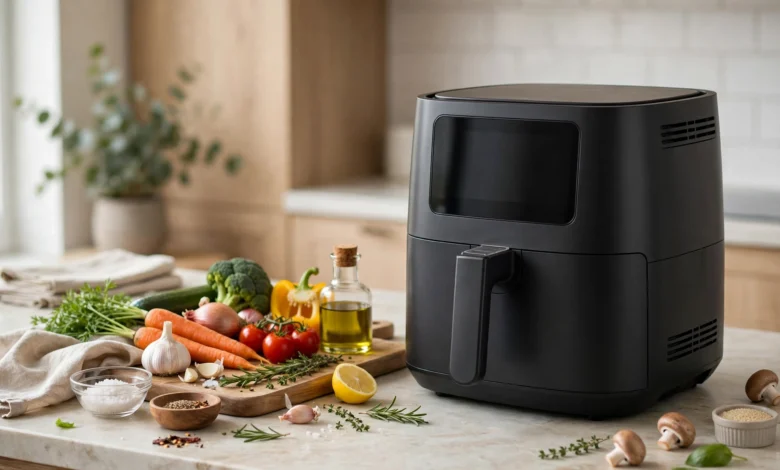
A Ninja air fryer has become one of the most common kitchen purchases in Britain, and also one of the most confusing, because the range now spans small single-drawer models, huge family machines, stacked designs, and portable options, all carrying the same brand name. The direct answer to the question most buyers really have is this: the right Ninja air fryer is the one that matches your household size, your counter space, and the way you actually cook, because a machine that is too small will force you to cook in batches, while a machine that is too large will dominate your kitchen and still only get used for chips. This guide is an explainer rather than a ranked shortlist, because the differences between formats matter far more than which model happens to be newest, and a clear understanding of drawers, capacities, and space will save you from the most common regret in this category.

It is also worth saying at the outset that an air fryer is not a magic health device, but it is a genuinely useful cooking tool, because it circulates very hot air rapidly around food, which produces crisp results with far less oil than deep frying, and it heats up faster and uses less energy than a full-size oven for small and medium meals. That combination of speed, crispness, and lower energy use is why so many households now reach for the air fryer on weeknights, but it only works if the machine fits the meals you actually cook, which is why size and format deserve more attention than colour, preset buttons, or any single headline feature.
How It Works, and Why Size Matters More Than Presets
An air fryer is essentially a small, powerful convection oven, which means it works by circulating extremely hot air at high speed around food in a confined space, and that confined space is precisely why size matters so much. The rapid air circulation creates the crisp exterior that people associate with frying, but it does so with only a light brushing or spraying of oil, and because the cooking chamber is small, it reaches temperature in minutes rather than the ten or fifteen minutes a conventional oven needs. That speed is the real everyday benefit, especially on busy weeknights, because it turns a meal that would take forty minutes in the oven into something ready in twenty, and it does so while using less electricity, since heating a small chamber takes far less energy than heating a whole oven cavity. The air fryer overview explains the convection principle in more detail, and it is worth reading if you want to understand why an air fryer is not simply a small oven with a fashionable name.
The consequence of that small chamber is that capacity is a hard limit, not a soft suggestion, because overfilling an air fryer basket blocks the airflow that makes the whole thing work, and the result is food that steams rather than crisps, cooks unevenly, and takes longer than it should. This is why a household of four cannot realistically rely on a small single-drawer model for family meals, no matter how good its reviews are, and why a single person does not need a huge dual-zone machine that takes up half the worktop. Preset buttons, by contrast, are almost irrelevant, because most experienced air fryer owners quickly learn that time and temperature matter far more than a picture of a chip or a chicken, and a machine with a simple manual control will cook just as well as one with twenty presets. Spend your attention on capacity and format, not on the number of buttons.
Formats: Single, Dual, Stacked, and Portable
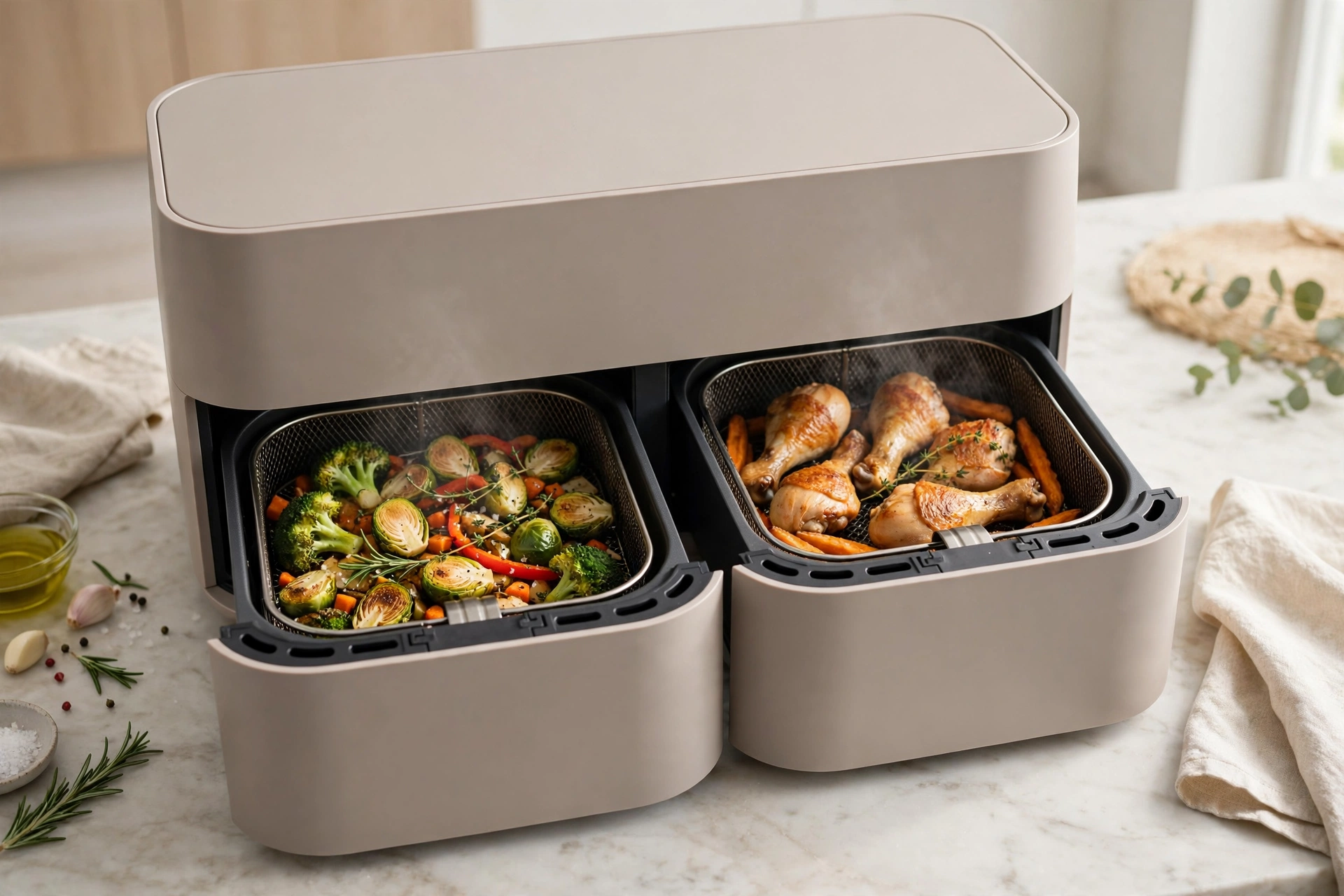
The Ninja range is best understood through its formats, because each one solves a different cooking problem, and choosing the wrong format is the most common source of disappointment. A single-drawer model is the simplest and most compact option, with one basket that suits one or two people cooking a single item at a time, and it is ideal for a small kitchen, a single person, or a couple who mainly cook one thing at a time and do not mind cooking in sequence. A dual-basket model, by contrast, has two independent drawers that can cook two different foods at different temperatures and times, and finish together, which is transformative for family cooking, because it means chips and chicken, or fish and vegetables, can be ready at the same moment rather than one going cold while the other cooks.
Stacked-drawer models take the dual concept further by placing the drawers one above the other rather than side by side, which saves worktop width at the cost of height, and they are a clever solution for kitchens where counter space is tight but vertical space is available. The FlexDrawer design goes further still, because it converts two separate drawers into one large cooking space when needed, which means the same machine can handle two small items on a weekday and a whole chicken or a large joint at the weekend. At the other end of the range sits the portable option, such as the Crispi, which is designed for smaller kitchens, caravans, or anyone who wants an air fryer that can be stored away easily, and it trades capacity for convenience in a way that suits some households perfectly and frustrates others. The right format, therefore, depends entirely on how you cook, not on which model is most popular.
Capacities: What the Litres Actually Mean for Dinner
Capacity figures are quoted in litres, but litres alone do not tell you how many people a machine will feed, because the usable cooking area matters more than the total volume of the drawer, and different foods fill a basket very differently. As a practical guide, the small AF100UK model, at 3.8 litres, is a genuine one-to-two-person machine, ideal for a single person or a couple cooking a single item, but it will struggle with a family meal and will force batch cooking for anything beyond a modest portion of chips or a couple of chicken breasts. The popular Dual Zone family models, at around 9.5 litres across two drawers, are the sweet spot for most families, because they can cook a main and a side simultaneously, or split a large portion across both drawers, and they handle weeknight family cooking without the batch-cooking frustration of a small machine.
The larger MAX models, at around 11 litres, suit bigger households, enthusiastic cooks, or anyone who regularly cooks for guests, because they can handle larger joints, whole chickens, and generous portions without crowding, although they also demand more counter space and more storage space when not in use. It is worth thinking in terms of real meals rather than litres: can this machine cook dinner for everyone at once, or will someone always be waiting for the second batch, and can it fit a whole chicken or a tray of roast vegetables without overcrowding? If the answer to the first question is no, then the machine is too small for your household, whatever its litre figure says, and if the answer to the second question is yes for a household of two, then you may be paying for capacity you will rarely use.
Counter Space: Measure Before You Buy
Counter space is the practical detail that ruins more air fryer purchases than any other, because these machines are far larger in real life than they look in a product photograph, and a large dual-zone model can be roughly the size of a microwave. Before buying, it is worth measuring the space where the machine will actually live, including the height under wall cupboards, because a stacked model may be too tall to sit under a cupboard, and the depth including the handle and any clearance needed for ventilation at the back. It is also worth thinking about where the machine will go when it is not in use, because a machine that lives on the worktop will be used far more often than one that lives in a cupboard and has to be hauled out, plugged in, and put away again for every meal.
The weight matters too, especially for stacked and large dual models, because a heavy machine that is awkward to lift will quickly become a permanent worktop resident whether you planned it that way or not, and that has implications for how much usable worktop you actually have left. If your kitchen is small, a single-drawer or portable model that can be stored easily may be a far better choice than a large dual machine that dominates the room, even if the larger machine looks better on paper. Conversely, if you have the space and you cook for a family, then a larger machine that lives permanently on the worktop and gets used daily is a far better investment than a small machine that frustrates you into ordering takeaway. Measure first, buy second, and you will avoid the most common regret in this category.
Cooking Reality: What It Does Well, and What It Does Not
An air fryer excels at a specific set of jobs, and understanding those jobs helps you judge whether it will earn its place in your kitchen or simply duplicate what your oven already does. It is superb for chips, roast potatoes, chicken pieces, sausages, vegetables, and anything that benefits from crisping, because the rapid hot air produces a genuinely crisp exterior with far less oil than frying, and it does so faster than an oven. It is also excellent for reheating, because it restores crispness to leftover pizza, pastries, and roast potatoes in a way that a microwave simply cannot, and many owners find that reheating becomes one of their most frequent uses. For small and medium meals, it is also more energy-efficient than heating a full oven, which matters both for bills and for keeping the kitchen cool in summer.
It is less good, however, at large roasts, wet batters, and anything that needs a large flat cooking surface, because the confined basket limits what fits, and foods that need to be cooked in a liquid or that produce a lot of steam will not crisp properly. It will not replace your oven entirely, and anyone who tells you otherwise is overselling it, but it will replace your oven for a large proportion of weeknight cooking, which is where the time and energy savings actually accumulate. The honest test of whether an air fryer is worth buying is not whether it can cook everything, but whether it can cook the meals you actually eat most often, faster and better than your current setup, and for most households the answer to that narrower question is yes.
Conclusion
Choosing a Ninja air fryer comes down to three honest questions: how many people are you cooking for, how much counter space do you actually have, and do you need two things cooking at once? A small single-drawer model suits one or two people in a compact kitchen, a dual-zone family model suits most households that cook for three or more, a stacked model suits a kitchen short on width but tall on space, and a portable model suits a small kitchen or a life on the move. The litre figure matters, but the real test is whether dinner for everyone can be cooked at once without overcrowding, and whether the machine will live somewhere convenient enough to be used daily rather than stored away and forgotten.
Presets, colours, and headline features are distractions compared with those three questions, and the money saved by ignoring them can go towards the size and format that actually fits your life. Measure the space, think about real meals rather than litres, and choose the format that matches how you cook, because a Ninja air fryer bought that way will be used several times a week for years, while one bought on impulse will be the most expensive kitchen ornament you own. Get the size right, and the air fryer will quickly become the hardest-working appliance in your kitchen.
FAQs
What size Ninja air fryer do I need for a family of four? For a family of four, a dual-zone model of around 9.5 litres is usually the sweet spot, because it can cook a main and a side at different temperatures and times and finish them together, which means nobody is waiting for a second batch while dinner goes cold. A small single-drawer model of 3.8 litres, such as the AF100UK, is a genuine one-to-two-person machine and will frustrate a family cook, while a larger 11-litre MAX model suits bigger households or anyone who regularly cooks for guests, although it demands more counter space in return for that capacity.
Is a dual-basket air fryer better than a single-basket one? A dual-basket model is better if you regularly cook two different foods that need different temperatures or times, because it lets you cook them simultaneously and finish them together, which is transformative for family meals where chips and chicken or fish and vegetables previously had to be cooked in sequence. A single-basket model is better if you mainly cook one item at a time, have a small kitchen, or cook for one or two people, because it is cheaper, smaller, and easier to store, and paying for a second basket you never use is money wasted on capacity rather than cooking.
What is a FlexDrawer, and is it worth it? A FlexDrawer is a design that converts two separate air fryer drawers into one large cooking space when needed, which means the same machine can handle two small items on a weekday and a whole chicken or a large joint at the weekend, without requiring a second appliance. It is worth it if your cooking varies between small weeknight meals and larger weekend cooking, because it gives you the flexibility of both formats in one machine, although it is less important if you always cook the same size of meal and never need the larger single space.
How much counter space does a Ninja air fryer need? A large dual-zone model can be roughly the size of a microwave, so you should measure the space where it will live, including the height under wall cupboards and the depth including the handle and ventilation clearance at the back, before buying. A machine that lives permanently on the worktop will be used far more often than one stored in a cupboard, so think about where it will go when not in use, and remember that a heavy stacked model may become a permanent resident whether you planned it that way or not.
Can an air fryer replace my oven? Not entirely, and it is important to be honest about this, because an air fryer excels at chips, roast potatoes, chicken pieces, vegetables, and reheating, all of which benefit from rapid hot air and crisping, but it struggles with large roasts, wet batters, and anything needing a large flat cooking surface. It will, however, replace your oven for a large proportion of weeknight cooking, which is where the time and energy savings accumulate, and most owners find that their oven gets used far less often once an air fryer earns its place on the worktop.
If you found this guide helpful, you may also enjoy our other home and appliance explainers on this site.