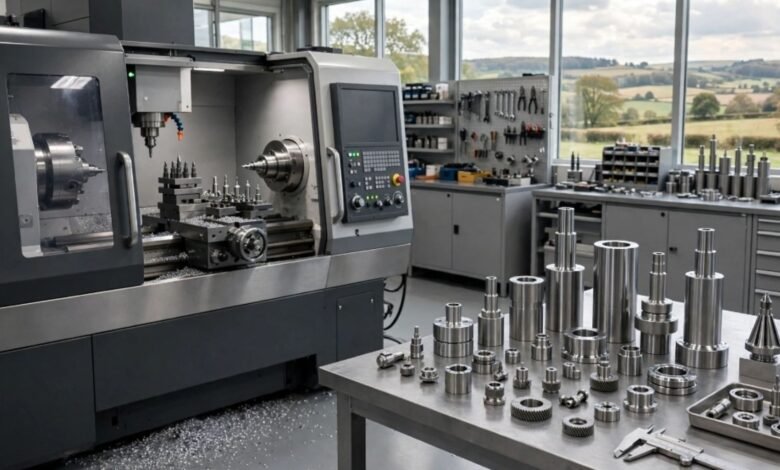
CNC turning is a key machining process for producing accurate components with consistent dimensions and reliable surface finishes. By using computer-controlled machining equipment, CNC turning can create precise cylindrical features while supporting repeatable production requirements.


For manufacturers that need CNC turning, the process can be part of a broader machining solution. Turning can be combined with operations such as facing, boring, drilling, threading, grooving and profiling to prepare components for further manufacturing, assembly or finishing.
What Is CNC Turning?
CNC turning is a computer-controlled machining process in which a workpiece rotates while a cutting tool removes material to create the required shape. The machining operation follows programmed instructions, helping produce consistent results across components and production runs.
The process is commonly used for components with cylindrical or rotational features. Depending on the design, turning can create external diameters, shoulders, grooves and other profiles while maintaining the dimensions required by the engineering specification.
How Does CNC Turning Work?
The CNC turning process starts by securely holding the workpiece and setting the required machining sequence. A cutting tool then follows a programmed path to shape the component accurately.
Material is removed gradually to achieve the required dimensions. Roughing and finishing operations can achieve the desired accuracy and surface finish.
Precision Turning for Engineering Components
Precision turning is suitable for components that require accurate dimensions and consistent machining. It can create important external features before further machining or finishing.
CNC machining allows programmed movements to be repeated consistently, making it suitable for production work, prototypes, repairs and one-off components. CA Honemaster also provides other specialist machining services.
What Machining Operations Can Be Included?
CNC turning can be combined with several machining operations depending on the component design and its intended application. These may include:
- Turning for producing cylindrical external surfaces
- Facing for preparing flat end surfaces
- Boring for producing or enlarging internal bores
- Drilling for creating required holes
- Threading for producing internal or external threads
- Grooving for creating defined recesses
- Profiling for producing shaped component features
Combining suitable operations can reduce unnecessary handling and help prepare a component efficiently for subsequent manufacturing stages.
CNC Turning and First Stage Machining
CNC turning can be part of first-stage machining, preparing raw or unfinished components for further machining and finishing. This stage helps establish the required dimensions and features.
CA Honemaster provides first-stage machining, including facing, turning, boring, drilling, gun drilling, rough machining, and material preparation. These processes can prepare components for later honing, grinding and threading.
Large Component and Specialist Machining
Larger components and complex internal features may require turning alongside additional machining processes. This allows different features to be produced as part of a coordinated machining process.
CA Honemaster offers large turning, boring, deep hole boring and gun drilling for components requiring accurate external dimensions and internal bores.
Why Is Dimensional Accuracy Important?
Dimensional accuracy matters when components must fit together or meet specific engineering requirements. Incorrect dimensions can affect assembly and performance.
CNC turning uses programmed movements to support consistent machining. Quality checks can help maintain the required dimensions and surface finish for further processing or assembly.
CNC Turning for Different Engineering Requirements
CNC turning is used across general engineering, precision engineering and specialist industrial applications where accurate rotational components are required.
CA Honemaster supports sectors including oil and gas, aerospace, hydraulic and pneumatic cylinders, and general engineering. Its services also include honing, deep-hole boring, gun drilling, and component refurbishment.
Choosing a CNC Turning Service
When selecting a CNC turning provider, it is useful to consider the company’s machining capabilities, engineering experience and ability to support the complete production requirement.
Important considerations include:
- The type and size of components that can be machined
- Available turning and associated machining operations
- Capacity for one-off, repair and production work
- Dimensional accuracy and quality control processes
- Ability to support further machining or finishing
- Experience with specialist engineering applications
CA Honemaster combines turning with first-stage and specialist machining services. Its ISO 9001 quality system supports consistent products and services.
CNC Turning for Efficient Component Preparation
CNC turning provides a controlled approach to producing accurately machined components while supporting repeatable manufacturing requirements. When integrated with facing, boring, drilling, threading, grooving and profiling, it can form part of a complete machining process.
For businesses requiring specialist CNC turning, choosing a provider with wider machining capabilities can simplify component preparation and support the transition from first-stage machining to later finishing operations. CA Honemaster combines turning with specialist engineering services, helping customers manage a range of machining and component requirements through an integrated approach.
When your business needs specialist CNC turning, a wider machining range can make it easier to prepare components and ease the transition from first-stage turning to later finishing. CA Honemaster integrates turning with specialist engineering services, supporting clients with their various machining and component needs.