With Flow Bus Lane: What It Means, How to Spot It and What the Theory Test Asks

With Flow Bus Lane: What It Means, How to Spot It and What the Theory Test Asks
A with flow bus lane is a bus lane in which buses travel in the same direction as the rest of the traffic on the road, and that single fact is the whole point of the phrase. If you are driving along a street and the bus in the lane beside you is heading the same way you are, you are looking at one, and the rule that matters most is the one in Highway Code Rule 141: you should not drive in a bus lane during its period of operation unless the signs indicate that your vehicle is permitted to use it. The term exists mainly so that learner drivers and theory-test candidates can tell this ordinary arrangement apart from its opposite, the contraflow bus lane, in which buses travel against the main flow of traffic, and confusing the two is one of the most common mistakes in the theory test.
The reason this small piece of vocabulary causes so much trouble is that most drivers never hear the phrase outside a theory-test revision book, even though they drive past with-flow bus lanes every single day without noticing them. One looks so normal that it barely registers: it is simply the left-hand lane of a busy road, marked with the words bus lane and separated by a solid white line, carrying buses in the same direction as everyone else while cars use the lanes beside it. This guide explains the Highway Code wording, the signs, the theory-test questions and the penalties, so that the phrase stops being a puzzle and becomes something you can recognise at a glance.
What Is a With Flow Bus Lane?
It is a lane reserved for buses and other permitted vehicles that runs in the same direction as the general traffic flow on that road, which means that a bus using it is travelling alongside cars, lorries and motorcycles rather than towards them. The words with flow are doing all the work in the phrase: flow means the direction in which the ordinary traffic on that road is moving, and with flow means going along with it, so a bus in such a lane is simply keeping pace with the rest of the street instead of cutting against it. Most bus lanes in British towns and cities are with-flow lanes, because they are created by taking the left-hand lane of an existing road and reserving it for buses during certain hours, which keeps public transport moving through congestion without changing the direction of anything.
Understanding the phrase matters because the theory test treats direction as the key fact, and it will show you a sign or describe a situation and ask you to decide whether buses are travelling with the traffic or against it. The Highway Code itself does not use that exact phrase in Rule 141, which simply defines bus lanes and says that you should not drive in one during its period of operation unless signs indicate otherwise, but the phrase is the standard way that the Driver and Vehicle Standards Agency, driving instructors and revision materials describe the arrangement. When you see a blue rectangular sign showing a bus symbol with no opposing arrows, or road markings that simply say bus lane, you are almost certainly looking at a with-flow arrangement, and the correct response is to stay out of the lane during its operating hours and to expect buses to be moving in the same direction as you.
How Does a With Flow Bus Lane Differ From a Contraflow Bus Lane?
The difference between the two is direction, and nothing else, yet that single difference changes the whole character of the road and the danger a driver faces. In a with-flow lane, buses move in the same direction as the rest of the traffic, so a driver who glances in the mirror sees them approaching from behind in the normal way, and a pedestrian crossing the road expects traffic from the usual direction. In a contraflow lane, by contrast, buses travel against the main flow, which means that on a one-way street a bus can appear to be coming towards you even though you are driving perfectly legally in the correct direction, and that is why contraflow lanes are marked with signs that show arrows pointing in opposite directions. The Highway Code deals with this directly in Rule 143, which says that on one-way streets traffic must travel in the direction indicated by signs, while buses and cycles may have a contraflow lane, and that short sentence is the legal foundation for the whole arrangement.
The signs are the quickest way to tell the two apart, and the theory test loves to test exactly that skill by showing you two similar blue signs and asking which one is which. A with-flow bus lane sign shows a bus symbol and usually no arrows at all, because there is nothing unusual about the direction to warn you about, whereas a contraflow sign shows the bus on one side of a dividing line with arrows pointing in opposite directions, making it clear that buses will be travelling against the rest of the traffic.
What Does the Highway Code Say About Bus Lanes?
The Highway Code covers bus lanes in Rule 141, and the wording is short enough to memorise word for word, which is exactly what theory-test candidates should do because the test frequently asks about it. Rule 141 states that bus lanes are shown by road markings and signs that indicate which, if any, other vehicles are permitted to use the bus lane, and that unless otherwise indicated, you should not drive in a bus lane during its period of operation, although you may enter a bus lane to stop, to load or unload where this is not prohibited. The key detail in that rule is the phrase during its period of operation, because bus lanes are not always in force: the sign at the start of the lane shows the hours during which the restriction applies, and outside those hours the lane is open to all traffic, so a driver who treats every bus lane as permanently closed to cars is being overcautious and may hold up traffic unnecessarily.
Rule 143 adds the other half of the picture, because it is the rule that explains one-way streets and the exception that allows buses and cycles to have a contraflow lane. It states that traffic must travel in the direction indicated by signs, that buses and cycles may have a contraflow lane, and that drivers should choose the correct lane for their exit as soon as they can, use the left-hand lane when going left, the right-hand lane when going right, and the most appropriate lane when going straight ahead, remembering that traffic could be passing on both sides. That last warning is the part that matters most for safety, because on a one-way street with a contraflow lane, a driver can have traffic passing on both sides at once, with ordinary vehicles on one side and a bus coming the other way on the other side, and a driver who has only ever met with-flow lanes will not be expecting it.
How Do You Recognise One on the Road?
You recognise one by reading the signs and the road markings together, because neither one on its own tells the whole story, and a careful driver checks both before deciding what to do. The first thing you will see is a blue rectangular sign at the start of the lane showing a white bus symbol, and alongside it a smaller plate giving the hours of operation, such as 7am to 7pm, together with any other vehicles that are allowed to use the lane, which may include taxis, cycles or motorcycles depending on the local traffic order. The absence of opposing arrows on that sign is itself a clue, because a contraflow sign needs arrows to show that buses travel against the traffic, while a with-flow sign does not, and the road surface will confirm the picture with the words bus lane painted in large white letters and a thick solid white line separating the lane from the general traffic.
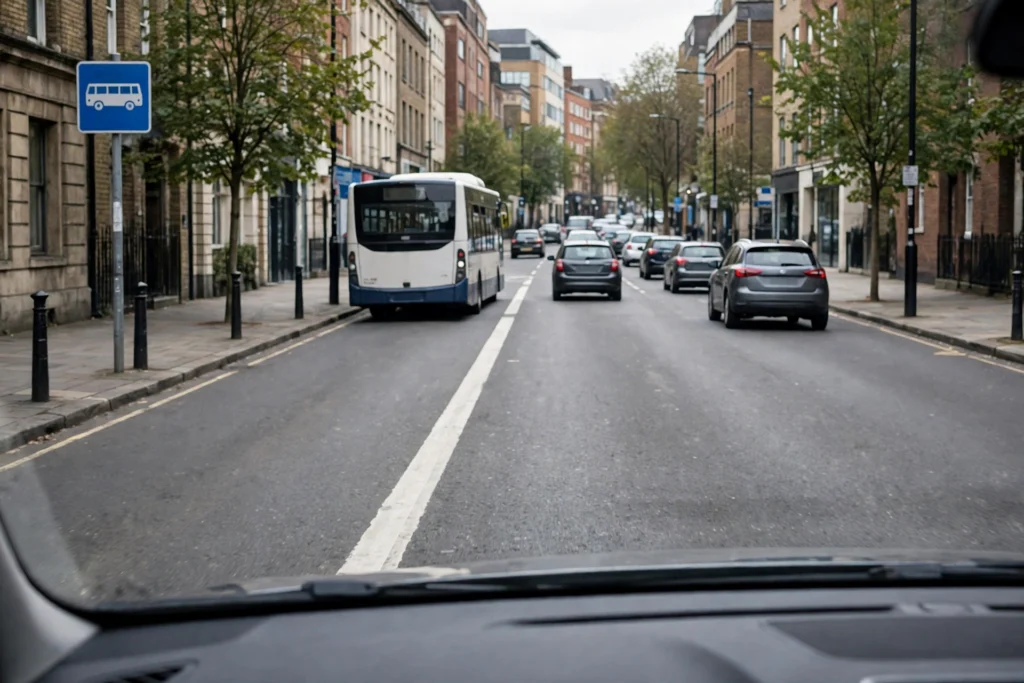
The second thing to watch for is the behaviour of the buses themselves, because a with-flow lane announces itself in the way traffic moves through it, and an observant driver can read the road even before reaching the sign. Buses in a with-flow lane pull in and out of bus stops on the left, merge back into the general traffic at the end of the lane, and queue in the same direction as the cars beside them, which means that the whole street moves as one stream with the buses simply given a clearer path through the congestion. A common learner mistake is to assume that the lane is still in force after the markings end, or to cross the solid white line early to get around a slow vehicle, and both errors are avoidable if you keep watching the markings and the signs rather than guessing. The habit to build is simple: see the blue sign, read the hours, respect the solid line, and expect buses to be travelling in the same direction as you, because that is what with flow means in practice.
What Does the Theory Test Ask About Bus Lane Signs?
The theory test asks about them in two main ways, and both of them are really tests of whether you can read a sign and understand direction, rather than tests of memorised facts. The first type of question shows you a picture of a blue rectangular sign and asks what it means, with answer options that mix up with-flow and contraflow, and the only way to answer correctly is to look at the arrows: if the sign shows a bus with arrows pointing in opposite directions, it is a contraflow lane, and if it shows a bus with no opposing arrows, it is a with-flow lane, so the picture itself contains the answer for any candidate who knows what to look for. The second type of question describes a situation, such as driving along a one-way street and seeing a bus coming towards you in a marked lane, and asks what you should do or what the lane is, and again the correct answer depends on recognising that buses may have a contraflow lane on a one-way street under Rule 143.
The best way to prepare is to revise Rules 141 and 143 together and then practise with sign-recognition questions until the difference between the two signs is automatic, because speed and confidence matter as much as knowledge in the multiple-choice test. Start by reading the exact wording of both rules on GOV.UK (https://www.gov.uk/guidance/the-highway-code/general-rules-techniques-and-advice-for-all-drivers-and-riders-103-to-158), then find pictures of the two signs side by side and quiz yourself on which is which, covering the labels and forcing yourself to decide from the arrows alone. Then think through the situations the test might describe: a bus travelling in the same direction as you in a marked lane is normal and expected, a bus travelling towards you on a one-way street is using a contraflow lane and is also legal, and in both cases your job is to stay out of the lane during its hours of operation and to give the bus room. The theory test does not ask trick questions about bus lanes, but it does ask precise ones, and precision comes from knowing that with flow means same direction, contraflow means opposite direction, and the sign always tells you which one you are looking at.
What Happens If You Drive in a Bus Lane by Mistake?
Driving in a bus lane during its hours of operation is normally dealt with by the local council rather than the police, and the usual consequence is a penalty charge notice sent to the registered keeper of the vehicle, which is a civil penalty rather than a criminal conviction and does not normally carry penalty points on your licence. The amount varies by area, and as of November 2026 the charge in London is higher than elsewhere in the country, but the process is similar everywhere: cameras record the vehicle using the lane, the council checks the footage against the operating hours shown on the signs, and a notice is posted to the keeper, who then has a limited time to pay at a reduced rate or to challenge the notice if they believe it was issued in error. A genuine mistake, such as being forced into the lane to avoid an obstruction, can be grounds for an appeal, but simply not noticing the signs is rarely accepted as an excuse, because the signs and markings are designed to be clear.
The more serious risk is not the fine but the safety consequence, because a driver who drifts into a bus lane without looking is likely to cut across a bus that is travelling faster than the congested traffic beside it, and buses are large vehicles that cannot stop quickly. A with-flow lane is less dangerous in this respect than a contraflow lane, because the bus is travelling in the same direction and the driver can see it in the mirror, but the risk is still real, especially near bus stops where buses pull out into the general traffic and where passengers may be crossing the road to reach the stop. The safest approach is to treat every solid white line beside a bus lane as a wall during the hours shown on the sign, to plan lane changes early, and to accept that staying in the general traffic for a few extra minutes is always better than a fine and a near miss with a bus.
Why Do Bus Lanes Like This Exist?
These lanes exist because buses carry far more people than cars, and giving them a clearer path through congestion makes the whole transport system work better for everyone, including the drivers who never use a bus themselves. A single double-decker bus can carry as many passengers as dozens of cars, so when a bus is stuck in the same queue as everyone else, dozens of people are delayed at once, whereas a reserved lane lets the bus keep moving and keeps to its timetable, which in turn encourages more people to leave their cars at home and reduces congestion further. The with-flow design is the cheapest and simplest way to achieve this, because it uses the existing left-hand lane of a road and simply reserves it during busy hours, rather than rebuilding the street or reversing the direction of traffic, and that is why most British towns and cities have chosen it over more complicated arrangements.
There is also a safety and environmental argument for with-flow lanes that goes beyond journey times, because a bus that keeps moving smoothly is easier for other drivers to predict than one that is constantly pulling in and out of traffic, and a reliable bus service takes cars off the road and reduces emissions in busy urban areas. For learner drivers, the practical lesson is that bus lanes are not an obstacle to be resented but a normal part of the road network to be understood, and that understanding the difference between with-flow and contraflow arrangements is part of becoming a driver who reads the road rather than merely following the vehicle ahead. The theory test asks about them for the same reason: a driver who understands why a lane exists is far more likely to respect it than one who has only memorised a rule.
Conclusion
A with flow bus lane is a bus lane in which buses travel in the same direction as the rest of the traffic, and once that simple definition is clear, everything else about the topic falls into place. Highway Code Rule 141 tells you not to drive in a bus lane during its period of operation unless the signs say your vehicle is permitted, Rule 143 explains that buses and cycles may have a contraflow lane on a one-way street, and the signs themselves tell you which arrangement you are facing, with a with-flow sign showing a bus and no opposing arrows while a contraflow sign shows arrows pointing in opposite directions. The theory test examines this distinction because it tests whether a driver can read a sign and understand direction before acting, and the penalty for getting it wrong on the road is a fine from the local council and a real risk of cutting across a bus. As of November 2026, these rules remain unchanged, and they will serve you on every drive, not just in the test centre, because with-flow lanes are the most common bus lane arrangement in the country. Learn the two signs, read the hours plate, respect the solid white line, and the phrase will never confuse you again. If you found this guide useful, our companion Highway Code guide to amber reflective studs on a motorway (https://ukblognews.co.uk/amber-reflective-studs-on-motorway/) explains another Rule 132 topic that the theory test asks about regularly, and reading the two together is a good way to revise the road markings section of the test in one sitting.
What is a with flow bus lane in simple terms?
A with flow bus lane is a bus lane where buses travel in the same direction as all the other traffic on the road, so a bus using it is heading the same way as the cars beside it. The phrase with flow means going along with the normal flow of traffic, and most bus lanes in the UK work this way because they are created by reserving the left-hand lane of an existing road. You must not drive in the lane during its hours of operation unless the signs say your vehicle is allowed, as set out in Highway Code Rule 141 as of November 2026.
How can you tell one from a contraflow bus lane?
You can tell them apart by looking at the blue sign, because a with-flow bus lane sign shows a bus symbol with no opposing arrows, while a contraflow bus lane sign shows arrows pointing in opposite directions to show that buses travel against the main traffic flow. The road markings also help, since both lanes are separated by a solid white line, but a contraflow lane sits on a one-way street where buses come towards you, which is allowed under Highway Code Rule 143. Remembering that with means same and contra means against is the quickest way to keep them straight in the theory test.
Can cars ever use one?
Cars can use one outside its hours of operation, because the restriction only applies during the period shown on the sign at the start of the lane, and outside those hours the lane is open to all traffic. Cars may also enter the lane to stop, to load or unload where that is not prohibited, as Highway Code Rule 141 allows, and some lanes permit other vehicles such as taxis, cycles or motorcycles, which will be shown on the sign. If the sign does not list your vehicle and the lane is in operation, you should stay out of it.
What does the Highway Code say about bus lanes?
Highway Code Rule 141 says that bus lanes are shown by road markings and signs that indicate which, if any, other vehicles are permitted to use the lane, and that unless otherwise indicated you should not drive in a bus lane during its period of operation, although you may enter it to stop, to load or unload where this is not prohibited. Rule 143 adds that on a one-way streets traffic must travel in the direction indicated by signs, while buses and cycles may have a contraflow lane. Both rules remain current as of November 2026 and are published on GOV.UK (https://www.gov.uk/guidance/the-highway-code/traffic-signs).
Will you get penalty points for driving in a bus lane?
You will not normally get penalty points for driving in a bus lane, because bus lane misuse is usually dealt with by the local council as a civil matter, resulting in a penalty charge notice sent to the registered keeper rather than a court fine or points on your licence. The amount varies by area and is higher in London than elsewhere, and the notice can be challenged if the lane was not in operation at the time or if you entered it for a permitted reason. However, entering a bus lane during a practical driving test can still count against you, so it is best to respect the signs at all times.


