Galaxy Z Flip 4: Full Specs, Camera and Battery Review

The Galaxy Z Flip 4 is Samsung’s clamshell foldable from August 2022, and its full specifications still read well in November 2026: a 6.7-inch Foldable Dynamic AMOLED 2X display with a 120Hz refresh rate, a 1.9-inch Super AMOLED cover display, a Qualcomm Snapdragon 8+ Gen 1 chip, 8GB of RAM, a choice of 128GB, 256GB or 512GB of storage, a dual 12MP rear camera with optical image stabilisation, a 10MP selfie camera, a 3,700mAh battery with 25W wired charging, and an IPX8 water resistance rating, all in a phone that weighs 187 grams and folds down to 84.9 by 71.9 by 17.1 millimetres. It launched on Android 12 with One UI 4.1.1, and Samsung’s update promise of four operating system updates and five years of security patches has taken it to Android 16 as of November 2026, with Android 17 expected as its final major update.
This review looks at the Flip 4 as a phone to use rather than as a list of numbers, because specifications only matter when they change how a phone feels in your hand, how it performs when you open an app, how it photographs your family, and how long it lasts before you reach for a charger. The phone was Samsung’s most refined clamshell foldable when it launched, and four years later it is the cheapest way into the foldable world, with refurbished models available from around £241 SIM-free in the UK, so the question is no longer whether it was good in 2022, but whether its design, display, performance, camera and battery still hold up in 2026, and this review answers that question section by section.
Design and Build: How the Fold Feels
The Flip 4 design is built around a single idea, which is that a full-sized phone should fold in half and disappear into a pocket, and the phone delivers on that idea with a hinge that feels precise, a frame that feels solid, and a folded shape that is genuinely small. When the phone is open it measures 165.2 by 71.9 by 6.9 millimetres, which is the size of a conventional smartphone, and when it is folded it measures 84.9 by 71.9 by 17.1 millimetres, which is roughly the size of a compact mirror, and that folded size is the reason people buy this phone, because it fits in pockets, small bags and jacket pockets where a full-sized phone would stick out or fall out. The Armor Aluminium frame and Gorilla Glass Victus Plus panels give the phone a premium feel, and the colours, including Bora Purple, Pink Gold, Graphite and Blue, still look distinctive four years after launch.
The build quality of the Flip 4 is better than its price suggests in 2026, because Samsung used flagship materials throughout, and the phone carries an IPX8 water resistance rating, which means it can survive being submerged in water, although it has no dust resistance rating, so it needs more care at the beach or on a building site than a conventional phone. The hinge is the most important part of the design, and it is rated to survive hundreds of thousands of folds, with a satisfying snap as it opens and a Flex Mode that holds the phone half-open at any angle, which lets you prop it on a table for hands-free video calls or time-lapse photos. The crease in the middle of the folding screen is visible when the light catches it, but it disappears when you look at the screen directly, and most owners stop noticing it within a few days, although it remains the one visible reminder that this is a folding phone rather than a flat one.
Display: The Folding Screen and the Cover Screen
The Flip 4 display is a 6.7-inch Foldable Dynamic AMOLED 2X panel with a resolution of 2640 by 1080 pixels, a 120Hz adaptive refresh rate that moves between 48Hz and 120Hz depending on what you are doing, HDR10+ support, and a peak brightness of 1,200 nits, which together make it one of the best screens on any phone at its current price. The screen is bright enough to read in sunlight, smooth enough that scrolling feels effortless, and colourful enough that photos and videos look vivid without looking artificial, and it is the same size and quality of display that you would find on a conventional flagship phone, which is the point of the folding design, since the phone gives you a full-sized screen and then folds it away. The ultra-thin glass layer over the folding panel is more durable than the plastic screens on earlier foldables, but it still needs more care than a flat glass screen, and Samsung recommends against pressing hard on the crease or using a fingernail on the display.
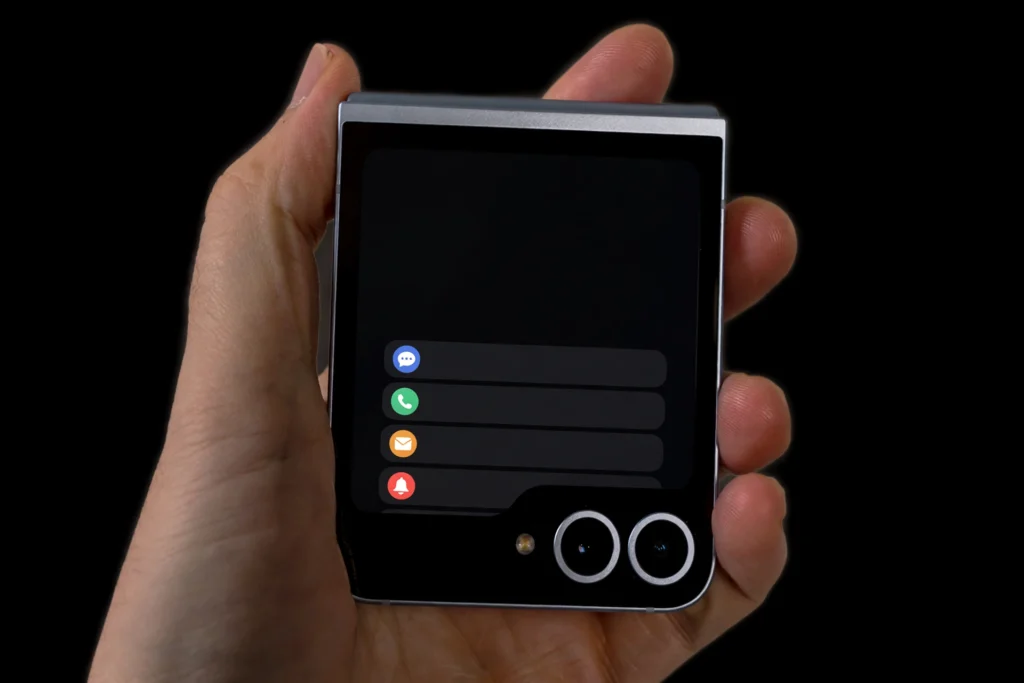
The cover screen on the Flip 4 is a 1.9-inch Super AMOLED panel with a resolution of 260 by 512 pixels, and it is the phone’s weakest feature in 2026, because it is much smaller than the 3.4-inch cover screen on the Flip 5 and the larger cover screens on the Flip 6 and Flip 7, which means it can show the time, notifications, music controls and a camera preview, but it cannot show much more, and you will open the phone far more often than owners of newer flips do. That small cover screen is the main reason the Flip 4 is cheap, and it is also the main reason to consider a Flip 5 instead if you can find one for a similar price, because the bigger cover screen transforms how the phone is used day to day. The cover screen is still useful for quick checks and for taking selfies with the rear cameras, and it is better than having no cover screen at all, but it is the one specification that shows the phone’s age most clearly.
Performance: Snapdragon 8+ Gen 1 in 2026
The Galaxy Z Flip 4 performance is powered by the Qualcomm Snapdragon 8+ Gen 1, a 4-nanometre flagship chip with an octa-core processor running at up to 3.19GHz, an Adreno 730 graphics processor, and 8GB of LPDDR5 RAM, and that combination remains fast enough in 2026 for everything most people do with a phone. Everyday tasks such as messaging, social media, web browsing, streaming video and taking photos feel instant, and the 120Hz display makes the whole interface feel responsive, while casual games run smoothly and even demanding games are playable, although the phone can get warm during long gaming sessions, and the smaller body gives the chip less room to shed heat than a larger phone would. The 8GB of RAM keeps multitasking smooth, with apps staying open in the background and switching quickly, although power users who keep dozens of apps open may notice the occasional reload.
The storage on the Flip 4 comes in three sizes, with 128GB, 256GB and 512GB options, all using fast UFS 3.1 storage, and there is no microSD card slot, so the storage you buy is the storage you keep for the life of the phone. The 128GB model can feel tight once you add apps, photos, videos and offline music, and the 256GB version is the smarter choice if the price difference is small, since it gives you room to grow without worrying about running out of space. The phone supports 5G on UK networks, Wi-Fi 6, Bluetooth 5.2, NFC for contactless payments, and a USB-C port, and it has a side-mounted fingerprint sensor that is fast and reliable, plus face recognition for unlocking, which together cover the security features that most people need, although there is no 3.5mm headphone jack, so wired headphones need a USB-C adapter.
Camera: What the Dual 12MP Setup Can Do
The Galaxy Z Flip 4 camera is a dual 12MP rear setup, with a 12MP wide camera with an f/1.8 aperture, optical image stabilisation and 1.8-micron pixels, plus a 12MP ultra-wide camera with an f/2.2 aperture and a 123-degree field of view, and a 10MP selfie camera with an f/2.4 aperture in a hole-punch cutout at the top of the main display. In daylight the wide camera takes sharp, colourful photos with good dynamic range, and the optical image stabilisation helps in low light, while the ultra-wide camera is useful for landscapes, group photos and tight interiors, although it is softer at the edges than the main camera, and the 10x digital zoom is best avoided, since it crops the image and loses detail quickly. The camera cannot match the sensors on newer flagships, but for social media, family photos and everyday memories it is more than good enough, and most owners will be happy with the results.
The folding design gives the Flip 4 camera an advantage that no conventional phone can match, because the cover display acts as a viewfinder, which means you can take selfies with the better rear cameras instead of the front camera, and you can see yourself on the small cover screen while you frame the shot. The Flex Mode hinge adds another advantage, because you can prop the phone half-open on a table and use it as its own tripod for hands-free photos, video calls and time-lapse videos, which is genuinely useful and something that flat phones cannot do without an accessory. Video recording goes up to 4K at 60 frames per second on the rear cameras, with stabilisation that keeps footage smooth while walking, and the phone also supports slow-motion video and night mode, although low-light video is noticeably noisier than daylight footage, and the small sensor shows its limits when the light drops.
Battery Life and Charging: The Honest Picture
The Galaxy Z Flip 4 battery is a 3,700mAh lithium-polymer cell, and it is the smallest battery in Samsung’s flip range, which means battery life is the phone’s most honest weakness, and the picture depends entirely on how you use the phone. With moderate use, including messaging, social media, some video streaming and a few photos, the battery gets most users through a day, but heavy users who play games, stream video at full brightness or use 5G all day will need a top-up in the evening, and the 120Hz display is the biggest drain, so switching to 60Hz or using power saving mode can add useful hours. The battery is non-removable, so a worn battery on a refurbished phone is the most important thing to check before buying, and buyers should ask the seller for a battery health report and buy from a seller who offers a warranty.
Charging on the Flip 4 is adequate rather than impressive, with 25W wired charging that takes the battery from empty to about half full in around half an hour, 15W wireless charging for convenience, and reverse wireless charging for topping up earbuds, although no charger is included in the box, so buyers need to use an existing USB-C charger or buy one separately. The phone supports USB Power Delivery, and a 25W charger is the fastest option, while a standard 15W charger will take noticeably longer, and wireless charging is slower still, so wired charging is the best choice when you are in a hurry. The honest verdict is that the battery is good enough for most people but not generous, and anyone who needs all-day battery life without thinking about charging should look at a phone with a larger battery, while anyone who is happy to top up in the evening will find the Flip 4 perfectly usable.
Conclusion
The Galaxy Z Flip 4 is a phone whose specifications still hold up well in 2026, with a superb 6.7-inch 120Hz folding display, a fast Snapdragon 8+ Gen 1 chip, a capable dual 12MP camera with a folding trick that no flat phone can match, and a design that folds a full-sized phone into a pocket-sized square. Its weaknesses are equally clear, with a small 1.9-inch cover screen, a modest 3,700mAh battery, and software support that ends with Android 17 as its final major update, but at refurbished prices from around £241 SIM-free in the UK, those weaknesses are priced in, and the phone offers far more than any mid-range phone at the same price. The review verdict is that the Flip 4 is a smart buy for anyone who wants a foldable without paying flagship money, provided they buy from a reputable seller with a warranty and check the battery health first.
The final advice is to choose the 256GB model if the price difference is small, to check the Flip 5 price before committing, since its bigger cover screen can make it the better buy for a similar amount, and to remember that the Flip 4’s greatest strength is its design, which still turns heads four years after launch. If you want to see how the Flip 4 compares with the newest flagships on the market, our guide to the OnePlus 15 price, specs, camera and release date explains what the latest phones offer and what they cost, and it will help you decide whether the Flip 4’s bargain price is worth the older specifications. Whichever phone you choose, the Flip 4 proves that a well-made foldable can stay relevant long after its launch, and that good design ages far more gracefully than raw specifications.
What Is the Flip 4?
The Flip 4 is Samsung’s clamshell foldable phone, launched in August 2022, and it folds a full 6.7-inch smartphone screen down into a pocket-sized square, with a 1.9-inch cover display on the outside for notifications and selfies. Its key specifications are a 6.7-inch Foldable Dynamic AMOLED 2X display with a 120Hz refresh rate, a Qualcomm Snapdragon 8+ Gen 1 chip, 8GB of RAM, a choice of 128GB, 256GB or 512GB of storage, a dual 12MP rear camera, a 10MP selfie camera, a 3,700mAh battery with 25W wired charging, and an IPX8 water resistance rating, all in a phone that weighs 187 grams. It launched on Android 12 and has been updated to Android 16 as of November 2026, with Android 17 expected as its final major update.
How Good Is the Camera?
The Galaxy Z Flip 4 camera is good for everyday photos, with a dual 12MP rear setup that includes a 12MP wide camera with optical image stabilisation and a 12MP ultra-wide camera with a 123-degree field of view, plus a 10MP selfie camera, and it takes sharp, colourful photos in daylight and acceptable photos in low light. The folding design gives the camera an advantage over conventional phones, because the cover display acts as a viewfinder, which means you can take selfies with the better rear cameras instead of the front camera, and the Flex Mode hinge lets you prop the phone half-open for hands-free photos and video calls. Video recording goes up to 4K at 60 frames per second, although low-light video is noticeably noisier than daylight footage, and the camera cannot match the sensors on newer flagships.
How Long Does the Battery Last?
The Flip 4 battery lasts most users through a day of moderate use, because its 3,700mAh cell is the smallest in Samsung’s flip range, and heavy users may need a top-up in the evening, especially if they use the 120Hz display at full brightness or play games. The phone supports 25W wired charging, which takes the battery from empty to about half full in around half an hour, and 15W wireless charging, although no charger is included in the box. Battery health matters more on a refurbished Flip 4 than on a new phone, so buyers should check the battery health and buy from a seller who offers a warranty, since a worn battery is the most common reason a used foldable disappoints.
Is It Waterproof?
The Flip 4 is water resistant rather than waterproof, and it carries an IPX8 rating, which means it can survive being submerged in water beyond one metre, although the exact depth and duration depend on the test conditions and Samsung does not guarantee protection against all water damage. The phone has no dust resistance rating, which is the X in IPX8, so it needs more care at the beach or on a building site than a conventional phone, and the folding screen and hinge should be kept clean and dry where possible. Water resistance can also weaken over time as seals age, so a four-year-old refurbished phone may not be as water resistant as it was when new, and buyers should treat the rating as a safety net rather than an invitation to use the phone underwater.
Will It Get Android 17?
Yes, the Flip 4 is expected to receive Android 17 as its final major operating system update, according to Samsung’s update promise of four operating system updates and five years of security patches, which was made when the phone launched in August 2022. As of November 2026 the phone is running Android 16, and Android 17 is expected to arrive as its last major version, after which the phone will continue to receive security patches for a limited time but will not get new Android versions. Buyers should be aware of this when choosing the phone, because it means the Flip 4 will stay secure for another year or so, but it will not keep up with newer phones on software features forever.


