Fender Serial Number Lookup: How to Date and Authenticate Your Guitar

Fender Serial Number Lookup: How to Date and Authenticate Your Guitar
A fender serial number lookup is the process of using the serial number stamped or printed on a Fender guitar or bass to work out when and where it was made, and for collectors it is the first step in deciding whether an instrument is what its seller claims it is. Fender publishes official dating guides through its support centre, with a separate chart for instruments made in the United States, Mexico, Japan, Korea and Indonesia, and a proper lookup means finding your number on the right chart for the right country, then cross-checking the result against the guitar’s features. The short answer is that the serial number usually gives you a year or a range of years rather than an exact date, because Fender itself warns that its serial numbering was often non-sequential and usually overlapped by two to four years, so the number is a guide, not a certificate. As of November 2026, Fender’s official dating pages remain the authority on the subject, and any lookup that ignores them is guessing.
The reason collectors care so much about a small string of letters and digits is that a Fender’s value can change dramatically with its age, and a guitar presented as a 1962 Stratocaster is worth many times more than the same model presented as a 1975 Stratocaster. Serial numbers are the most visible clue to that age, because they are printed on the outside of the instrument where anyone can read them, but they are also the easiest clue to misunderstand, since Fender changed its numbering system repeatedly, ran parallel systems in different countries, and reused formats for reissue models that deliberately copy vintage guitars. This guide explains how the official lookup works, where to find the number, what the prefixes mean, how collectors combine the serial with other evidence, and where the traps lie, so that you can date a Fender with honest confidence instead of false precision.
What Is a Fender Serial Number Lookup?
A fender serial number lookup is the step-by-step process of taking the serial number from a Fender instrument, identifying which numbering system it belongs to, and matching it against Fender’s published dating charts to estimate the year of manufacture. The lookup starts with the country of manufacture, because Fender has run separate numbering systems in the United States, Mexico, Japan, Korea and Indonesia, and a prefix that means one thing on an American guitar can mean something entirely different on a Mexican or Japanese one. Once you know the country, you find the chart for that country on Fender’s official support pages, locate the range or prefix that contains your number, and read off the production dates that Fender assigns to it, which will usually be a range of one to four years rather than a single year. That range is the honest answer, and any website or seller that gives you a single precise year from a vintage serial number alone is overstating what the number can prove.
It is important to understand what a lookup can and cannot do, because unrealistic expectations are the main reason collectors get disappointed or misled. A lookup can tell you which system your guitar belongs to, roughly when it was made, and whether the serial is consistent with the model and features you can see, which is often enough to confirm a guitar is genuine or to raise a warning flag. It cannot tell you the exact day a guitar left the factory, it cannot prove that every part on the guitar is original, and it cannot by itself distinguish a careful fake from a genuine instrument, because serial numbers can be copied onto decals and neck plates. Fender is unusually candid about these limits, stating in its own dating guidance that dating by serial number is not always precisely definitive, and that the charts are meant only as guides. The collectors who use serial numbers best are the ones who treat the lookup as the beginning of an investigation rather than the end of one, and who always check the number against the neck date, the hardware and the finish before reaching a conclusion.
Where Do You Find the Serial Number on a Fender?
Finding the serial number is the first practical step, and its location depends on the age and model of the instrument, which is itself a useful clue about what you are holding. On most modern Fender guitars and basses, the serial number is on the back of the headstock, usually printed on the decal alongside the country of manufacture, and it is easy to read without taking anything apart. On older American instruments made between 1954 and 1976, the number is stamped into the metal neck plate on the back of the body where the neck joins it, and on the very earliest instruments from 1950 to 1954, it appears on the bridge plate of Telecasters, Esquires and Precision Basses, or on the tremolo spring cover of the first Stratocasters. Fender’s own support guidance confirms these locations, noting that serial numbers have also appeared on the front or back of the headstock and on the back of the neck near the body joint at different periods, so if you cannot find the number in one place, it is worth checking the others before assuming it is missing.
For acoustic Fender guitars, the serial number is most often found inside the soundhole, printed on the label visible through the hole, while on Fender amplifiers it is usually on the back of the cabinet or chassis, which means that a guitar lookup and an amplifier lookup are two different exercises with different charts. When you find the number, photograph it and write it down exactly as it appears, including every letter and digit in the correct order, because a single misread character can move a guitar into the wrong decade: the difference between an S prefix and a Z prefix is the difference between the 1970s and the 2000s. Also note the words around the number, such as Made in Mexico, Crafted in Japan or Made in USA, because those words identify the country of manufacture, and the country decides which dating chart you need. If the number is faint, worn or partly hidden under hardware, use a bright light and a magnifying glass rather than guessing, and never scratch or clean aggressively to reveal it, because damaging the decal or the finish will reduce the guitar’s value far more than an unread number ever could.
How Does Fender’s Official Dating Guidance Work?
Fender’s official dating guidance works through a set of country-specific articles published on its support centre, each covering the instruments made in one country, and the correct way to use them is to pick the article that matches the country marked on your guitar. The American-made guide is the longest and most detailed, because Fender’s United States production stretches back to 1950, and it explains that production dates were pencilled or stamped on the butt end of the heel of the neck on most guitars and basses, although there were periods, such as 1973 to 1981, when this was not done consistently or was simply omitted. The same guide warns that the neck date refers to the date the individual neck component was produced rather than the complete instrument, because Fender’s modular production meant that a neck could be made in one year, stored for a period, and then paired with a body later, so even the neck date is approximate rather than definitive. The Mexican, Japanese, Korean and Indonesian guides follow the same pattern, each giving the serial schemes used in that country with their production dates, and each carrying the same honest warning that the charts are guides rather than guarantees.
The reason Fender publishes separate guides instead of one universal lookup is that the company’s history is really several histories running in parallel, and a single chart could not honestly cover them all. Fender began producing instruments in its Ensenada factory in Mexico in 1990, moved some production from Korea to Indonesia in 2008, and has built guitars in Japan under different arrangements since the early 1980s, so each country developed its own prefixes, its own sequences and its own quirks. The official guides reflect that reality, and they are the most reliable starting point for any lookup, because they come from the manufacturer rather than from a third-party site that may have copied the data with errors. As of November 2026, the guides are freely available on Fender’s support site, and a collector who works through them methodically will reach a more accurate answer than one who types a number into a random decoder and accepts the first result. The guides also explain the exceptions, such as the American Vintage Series and artist models, which is exactly the information that separates a careful lookup from a careless one.
What Do the Letter Prefixes Mean?
The letter prefixes in a Fender serial number are the fastest way to identify which decade and which country a guitar comes from, because Fender has used letters to encode the decade since the late 1970s. On American instruments, an S prefix denotes the 1970s, which was Fender’s attempt under CBS ownership to use serial numbers to identify production years, and an E prefix was introduced in 1979 to denote the 1980s, so the second character is usually a digit giving the specific year within the decade, as in E4 for 1984 or N9 for 1999. The N prefix denotes the 1990s and the Z prefix denotes the 2000s, while instruments made from March 2010 onwards mostly carry a US prefix followed by eight digits, with the first two digits giving the year directly, so US10 means 2010 and US24 means 2024, and the remaining six digits are a unit identifier that is not sequential and carries no further information. That US system is the cleanest Fender has ever used, because the year is written into the number itself, and it is the reason that dating a modern American Fender is usually straightforward.
Mexican instruments use their own prefixes, and recognising them is essential because Mexican-made Fenders are among the most widely owned guitars in the world. Instruments made in Mexico between 1990 and 2000 carry an MN prefix, with the M designating Mexico and the N designating the 1990s, and at the end of 1999 the prefix changed to MZ, with the Z designating the 2000s, following the same decade-letter logic as the American system. From around 2010, Mexican instruments mostly use an MX prefix followed by an eight-digit number, with the first two digits identifying the year of manufacture, so MX17 means a guitar made in 2017, and the same year-in-the-number logic applies. Japanese instruments have used JV for the early 1980s, single letters under the Made in Japan and Crafted in Japan decals through the 1990s and 2000s, and JD followed by eight digits from 2012, with the first two digits again giving the year, while Korean instruments have used CN, VN and KC prefixes and Indonesian instruments have used IC and ICF, with the first two digits giving the year in the later systems. Learning these prefixes takes an afternoon, but it turns a confusing jumble of letters into a readable code, and it is the single most useful skill in any serial number lookup.
How Do Collectors Use Serial Numbers to Date a Guitar?
Collectors use serial numbers to date a guitar by treating the number as one piece of evidence among several, starting with the lookup and then testing the result against everything else the guitar can tell them. The process usually begins with reading the serial and identifying the country and era from its prefix, which gives a first estimate, often a range of two to four years, and the collector then looks for the neck heel date, which is pencilled or stamped on the butt end of the neck and is visible only when the neck is removed from the body. Fender’s own guidance says that removing the neck is the only way to narrow the date range for many instruments, and it advises anyone uncomfortable doing this to ask an experienced guitar technician, because a careless neck removal can damage the instrument. The neck date outranks the serial number when the two disagree, because the neck date refers to a specific component made on a specific date, while the serial number was often applied from plates and decals made in advance and used out of order, so a guitar whose serial suggests 1963 but whose neck is dated 1964 is most likely a 1964 guitar.
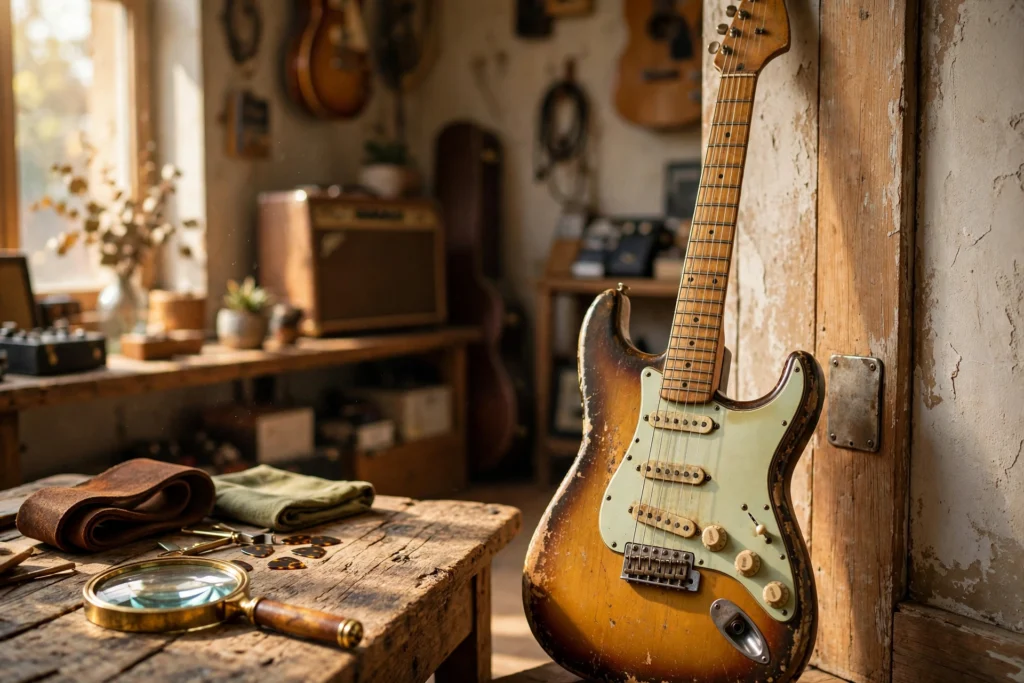
Beyond the neck date, collectors check the potentiometers, the pickups, the bridge, the tuners and the finish, because each part changed at a known point in Fender’s history, and a part that is too new or too old for the serial’s date range is a warning sign. A guitar with a 1960s serial number but 1980s potentiometers has almost certainly been modified or assembled from parts, which does not make it worthless but does mean it is not an all-original vintage instrument, and its value should reflect that. Collectors also compare the guitar against catalogues and known examples from the same period, looking at details such as the shape of the headstock decal, the style of the logo, the number of screws on the pickguard and the type of fretboard wood, because Fender changed these details gradually and each change narrows the date. The serial number starts the investigation, but it is the combination of the serial, the neck date and the hardware that produces a date a collector can trust, and a seller who can show all three pieces of evidence is offering something far more convincing than a seller who can only quote a serial number.
How Do Serial Numbers Help Authenticate a Fender?
Serial numbers help authenticate a Fender by revealing inconsistencies that a fake or a misdescribed guitar cannot easily hide, because a forger must get every detail right at once, and the serial is only one of them. The first check is whether the serial format matches the model and the country: a Stratocaster claiming to be a 1965 American original should have its number on the neck plate with the large script F logo that Fender used from 1965, while a guitar claiming to be a 2015 American Standard should have a US prefix with the year encoded in the first two digits, and a mismatch between the format and the claimed date is a strong reason to walk away. The second check is whether the serial is consistent with the guitar’s features, such as the headstock shape, the decal style, the bridge type and the finish, because Fender changed these features over time, and a guitar that mixes a 1970s serial with a 1990s headstock is either a parts guitar or a fake. The third check is the simplest and most often skipped: whether the serial appears in the right place and in the right style, because genuine Fender decals and stampings have a consistent look, while fakes often have numbers that are too crisp, too faint, in the wrong font or in a location Fender never used.
Authentication also depends on knowing the limits of what a serial can prove, because an authentic serial number does not guarantee an authentic guitar. Neck plates and decals can be bought, swapped or reproduced, so a genuine 1970s neck plate on a newly built body will pass a serial check while failing every other test, and that is why experienced buyers never authenticate on the serial alone. They check the wood, the solder joints, the wear patterns, the case and the paperwork, and they ask for the neck to be removed so the heel date can be read, because the heel date is much harder to fake convincingly than a serial number. If the guitar is valuable enough, they will also consult a recognised expert or a reputable dealer before buying, and they will be wary of any seller who refuses to allow inspection or who pressures for a quick sale. A fender serial number lookup is therefore best understood as a screening tool: it can quickly eliminate obvious fakes and misdated guitars, and it can confirm that a guitar is at least plausible, but the final judgement always rests on the whole instrument, not on a single number.
What Are the Traps and Exceptions to Watch For?
The traps and exceptions in Fender serial numbers are numerous enough that every collector needs to know the main ones before trusting any lookup, because each trap can move a guitar by years or turn a reissue into an apparent vintage original. The biggest trap is overlap: Fender’s own charts show that serial ranges overlap by two to four years, because plates and decals were made in advance and used out of order, so a number that appears in both the 1963 and 1964 ranges is genuinely ambiguous, and anyone who insists it must be one year or the other is pretending to a precision the system does not support. The second trap is the V prefix, which denotes the American Vintage Series introduced in 1982, and which encodes no year at all, so a V serial cannot date a guitar by itself and must be read alongside the model and the neck date. The third trap is the N9 prefix, which Fender applied to some instruments built in 1990 as well as to those built in 1999 and 2000, making it one of the most confusing prefixes in the whole system, and the fourth is the reissue problem: Fender has deliberately made guitars that copy vintage serial formats, so a reissue Stratocaster can carry a number that looks exactly like a 1950s original until you check the model and the features.
There are also country-specific traps that catch even experienced buyers, and the Japanese and Korean systems are the worst offenders. Fender’s own Japanese guide states that records on early Japanese-made instruments are not complete and are therefore not completely definitive for dating, which means that a Japanese serial from the 1980s may give only an approximate answer, and the change from Made in Japan to Crafted in Japan decals in 1997, and back again in 2007, adds another layer of complexity. Korean instruments made before 1993 are even harder to date, because Fender’s digital records only go back to mid-1993, with little information available on serial numbering from 1988 through 1992, so dating for that period is highly uncertain by Fender’s own admission. The practical lesson is to treat every lookup result as a range, to distrust any source that gives a single exact year for a pre-1990 instrument, and to remember that the exceptions are not rare footnotes but a normal part of Fender’s history. A collector who knows the traps will date guitars more slowly but far more accurately than one who trusts the first number a decoder produces.
Conclusion
A fender serial number lookup is a powerful tool for dating and authenticating a Fender guitar, but only when it is done the way Fender itself recommends: find the number, identify the country, use the official dating chart for that country, and accept the range of years it gives rather than forcing it into a single year. The prefixes tell the story at a glance, with S for the 1970s, E for the 1980s, N for the 1990s, Z for the 2000s and US, MX and JD systems encoding the year directly from 2010 onwards, while the earliest instruments from 1950 to 1954 used numbers up to 6,000 on the bridge plate or tremolo cover. The serial is the beginning of the investigation, not the end, and the neck heel date, the hardware and the finish must all agree before a date can be trusted, because Fender’s own guidance warns that serial numbering was often non-sequential and overlapped by two to four years. As of November 2026, the official Fender support guides remain the best source for any lookup, and a collector who works through them carefully, watches for the V prefix, the N9 confusion and the reissue trap, and checks the whole guitar rather than just the number, will rarely be misled. That careful approach is what separates a genuine find from an expensive mistake, and it is the reason the serial number, small as it is, matters so much.
How do I do a fender serial number lookup?
To do a fender serial number lookup, find the serial number on the back of the headstock or on the neck plate, note the country of manufacture printed beside it, and match the number against Fender’s official dating chart for that country on the Fender support site. The chart will give you a production year or a range of years, usually overlapping by two to four years for older instruments. For a narrower date, check the production date stamped or pencilled on the butt end of the neck heel, which requires removing the neck, ideally by a qualified guitar technician.
Where is the serial number on a Fender Stratocaster?
On most Fender Stratocasters, the serial number is on the back of the headstock, printed on the decal, and on modern instruments the country of manufacture is printed beside it. On American Stratocasters made between 1954 and 1976, the number is stamped on the metal neck plate on the back of the body, and on the very first Stratocasters from 1954 it was stamped on the back vibrato cover plate. Fender’s support guidance confirms these locations, and it notes that the number has also appeared on the front of the headstock and on the back of the neck at different periods.
Can a Fender serial number tell you the exact year?
A Fender serial number can tell you the exact year for most instruments made from 2010 onwards, because the US, MX and JD systems encode the year in the first two digits, so US24 means 2024 and MX17 means 2017. For older instruments, the serial usually gives a range of years rather than an exact year, because Fender’s numbering was often non-sequential and overlapped by two to four years. Fender’s own guidance states that dating by serial number is not always precisely definitive, so the neck heel date is the best way to narrow the range.
What does the V prefix mean on a Fender serial number?
The V prefix on a Fender serial number denotes the American Vintage Series, which was introduced in 1982, and it does not encode a year, so a V serial cannot date a guitar by itself. Older V serials from 1982 to 2012 have four to six digits that carry no year information, while American Vintage instruments relaunched in mid-2012 use V followed by seven digits, with the first two digits giving the year. To date a V-prefix guitar, you need to identify the model and check the neck heel date and the hardware.
How can you tell if a Fender is fake from its serial number?
You can spot a possible fake by checking whether the serial format matches the claimed model, country and date, whether the number is in the location Fender used for that period, and whether it is consistent with the headstock shape, decal style and hardware. A mismatch in any of these is a warning sign, but a matching serial alone does not prove a guitar is genuine, because neck plates and decals can be copied or swapped. Always check the neck heel date, the solder joints, the wear patterns and the paperwork, and consult a reputable dealer or expert before buying a valuable instrument.


