Pelican vs Puffin Crossing: A Pedestrian’s Guide to Crossing Safely

A pelican crossing is a pedestrian light-controlled crossing where you press a button, wait for the green man on the far side of the road, and cross while the traffic light is red, while a puffin crossing is a pedestrian user-friendly intelligent crossing where the green man appears on a signal box beside you at the kerb, and sensors watch you all the way across to make sure the traffic stays stopped until you are safely on the other side. The difference matters to every person on foot, because the puffin’s sensors give slower walkers more time, while the pelican’s fixed timings and flashing green man expect you to finish crossing within a set period. The rules for pedestrians are set out in the Highway Code, with pelican crossings covered by Rule 22 and puffin crossings covered by Rule 23, and as of November 2026 those rules have not changed.
Most people use these crossings without ever thinking about which type they are standing at, and that is understandable, because both have a push button, both show a red man and a green man, and both stop the traffic for you, so the experience feels the same from the kerb. The differences only become visible when something goes wrong, such as when a green man starts flashing while you are halfway across, or when you are walking slowly and the traffic light changes before you reach the other side, and that is exactly when knowing the pelican vs puffin crossing difference can keep you safe. This guide explains both crossings from the pedestrian’s point of view, so that you know what each signal means, where to look, and how much time you really have.
What Is a Pelican Crossing and How Do You Use It?
A pelican crossing is a signal-controlled crossing operated by pedestrians, and using it starts with the push button on the control box at the kerb, which you press to activate the traffic signals and tell the system that someone wants to cross. When the red figure shows, you must not cross, and you should wait at the kerb until the steady green figure appears, which is the signal that you may start crossing, although the Highway Code still advises you to check that the traffic has actually stopped before you step off the pavement, since a green man is a permission and not a guarantee. The green figure on a pelican crossing appears on the far side of the road, across the street from where you are standing, which means you have to look across the traffic to see it, and that is the first thing that makes a pelican different from a puffin.
The part of the pelican crossing that confuses most pedestrians is what happens after the green figure, because when the green figure begins to flash, you should not start to cross, but if you have already started you should have time to finish crossing safely, and that is the rule set out in Rule 22 of the Highway Code. The flashing green man is followed by a flashing amber light for drivers, which tells them to give way to anyone still on the crossing but allows them to proceed if the crossing is clear, and that is why it is so important not to start crossing on a flashing green man, since the traffic may begin moving while you are still on the road. If you are halfway across when the green man starts to flash, keep walking steadily towards the other side, do not run, do not turn back, and do not stop in the middle of the road, because the timings are designed to give you enough time to finish, and the drivers are required to wait for you.
What Is a Puffin Crossing and How Do You Use It?
A puffin crossing is a signal-controlled crossing with sensors that detect pedestrians waiting at the kerb and crossing the road, and using it starts in the same way as a pelican, with a push on the control button, but everything after that is different in ways that make it safer and easier to use. The red and green figures on a puffin crossing are mounted above the control box on your side of the road, at the kerb where you are standing, rather than across the street, which means you can see the signal without looking across the traffic, and you can watch it while you wait without turning your head away from the road. When the red figure shows, you must not cross, and when the steady green figure shows, you may start crossing, after checking that the traffic has stopped, just as you would at any other crossing.
The sensors are what make a puffin crossing special, because kerbside detectors register that you are waiting, and on-crossing detectors watch you as you walk across, and those sensors tell the signals to hold the red light for traffic for as long as you need, which means the lights will not change while you are still on the road. There is no flashing green man and no flashing amber phase at a puffin crossing, and the traffic lights follow the same sequence as an ordinary set of traffic lights, which removes the uncertainty that the pelican’s flashing signals create. If you are walking slowly, using a stick or a frame, or pushing a pram, the puffin’s sensors give you the time you need, and that is the reason that new crossings are now usually built as puffins rather than pelicans, even though thousands of pelican crossings remain in use across the country.
Pelican vs Puffin Crossing: What Is Different for the Person Crossing?
The pelican vs puffin crossing difference for the person crossing comes down to three things: where the signal is, how much time you get, and what happens when the signal changes, and each of those differences favours the puffin for slower walkers. On a pelican crossing the green man is across the road, which means you have to look away from the traffic beside you to see it, and on a puffin crossing the green man is beside you at the kerb, which means you can watch the signal and the road at the same time, and that small difference matters most for children and older people, who need to keep their eyes on the traffic while they decide when to step out. The signal position is the quickest way to tell which crossing you are standing at, because if the green man is across the street it is a pelican, and if it is beside you at the kerb it is a puffin.
The second difference is time, because a pelican crossing runs on fixed timings that assume an average walking speed, and once the green man starts flashing the clock is running, while a puffin crossing uses sensors to measure how long you actually need, and it extends the red phase for traffic until you have cleared the road. The third difference is what happens when the signal changes, because a pelican’s flashing green man tells you not to start crossing but gives you time to finish, and a puffin’s steady green man simply goes out when the phase ends, with no flashing stage at all, which means there is no ambiguous signal to interpret while you are in the middle of the road. Together those three differences make the puffin the safer crossing for anyone who walks slowly, and they explain why the Department for Transport has favoured puffin crossings for new installations since the 1990s, even though the older pelican design is still common on British streets.
Why Do Puffin Crossings Use Sensors, and Who Do They Help Most?
Puffin crossings use sensors because the fixed timings of the older pelican design did not work well for everyone, and the people who suffered most were those who walk slowly, including older people, disabled people, parents with small children, and anyone carrying heavy shopping or pushing a pram. The pelican’s green man phase was set to a standard walking speed, and if you walked more slowly than that standard, the green man would start flashing while you were still on the road, and the traffic would be given a flashing amber light that allowed drivers to proceed if they thought the crossing was clear, which put slow walkers at risk. The puffin was designed to solve that problem, and its name, pedestrian user-friendly intelligent crossing, describes exactly what the sensors do, because they watch the crossing and hold the traffic until every pedestrian has finished. That is the practical payoff of the pelican vs puffin crossing design change.
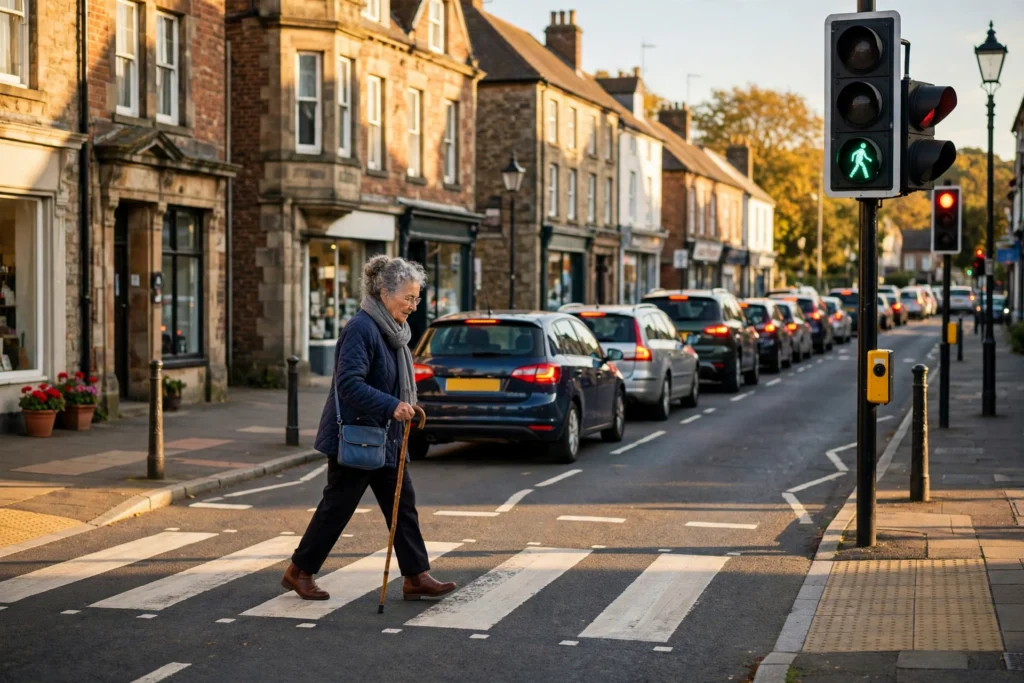
The people who benefit most from puffin sensors are older pedestrians, and the statistics on pedestrian casualties show why that matters, because older people are more likely to be injured when crossing the road, and they are also more likely to walk slowly, which means they are the group most exposed to the pelican’s fixed timings. Children benefit too, because the near-side signal means they do not have to look across the road to see the green man, and parents can watch the signal and their child at the same time, while wheelchair users benefit because the sensors detect them at the kerb and give them a longer phase. The sensors are not perfect, and a pedestrian who stands at the kerb without pressing the button will not be detected, so the button still matters, but for anyone who presses it, the puffin is a crossing that adapts to the person using it rather than expecting the person to adapt to the crossing.
How Should Children, Older People and Parents Use These Crossings?
Children should be taught to use pelican and puffin crossings in the same careful way, and the first lesson is the Green Cross Code, which the Highway Code sets out in Rule 7 and which every child should learn before they are allowed out alone. The Code advises children to find a safe place to cross, to use a crossing where one is nearby, to wait for the green man, to check that the traffic has stopped, and to keep looking and listening while they cross, and those steps apply at both types of crossing, although the puffin’s near-side signal makes the waiting stage easier for a child to understand. Parents should walk the route with their children until the child can use the crossing confidently on their own, and they should practise pressing the button, waiting for the green man, and crossing without running, because a child who runs is a child who can trip, and a child who trips on a crossing is in danger.
Older people and parents with prams should favour puffin crossings where they have a choice, because the sensors give them more time, and they should press the button and wait for the steady green figure rather than trying to cross on a gap in the traffic. If you are walking slowly and the green man starts flashing at a pelican crossing, keep walking steadily towards the other side and do not turn back, because the timings are designed to let you finish, and the drivers are required to give way to you. If you feel unsure, wait for the next green man rather than rushing, and remember that no crossing is worth hurrying for, since the traffic will stop again in a minute, and the safest crossing is always the one you make calmly, with time to spare, and with your eyes on the road rather than on your phone.
Conclusion
In a pelican vs puffin crossing comparison, a pelican is a pedestrian light-controlled crossing with far-side signals and a flashing green man, while a puffin is a pedestrian user-friendly intelligent crossing with near-side signals and sensors that hold the traffic until you have finished crossing, and the puffin is the safer of the two for anyone who walks slowly. The pelican expects you to cross within a fixed time, and its flashing green man tells you not to start but gives you time to finish, while the puffin watches you with its sensors and extends the red light for as long as you need, with no flashing stage to interpret. The rules are set out in the Highway Code, with pelican crossings covered by Rule 22 and puffin crossings covered by Rule 23, and as of November 2026 those rules have not changed, although new crossings are now usually built as puffins.
The practical lesson for every pedestrian is to press the button, wait for the steady green figure, check that the traffic has stopped, and cross steadily without running, and to teach children the Green Cross Code before they cross alone. If you are walking slowly, choose a puffin crossing where you can, because its sensors are designed for you, and if you are at a pelican crossing and the green man starts flashing while you are halfway across, keep walking to the other side and do not turn back. If you want to understand more about the roads around you, our guide to automatic railway level crossings explains another type of crossing where the same careful habits keep you safe, and together the two guides cover the crossings that pedestrians meet most often on British roads.
What Is the Difference Between a Pelican and a Puffin Crossing?
In a pelican vs puffin crossing comparison, the difference is that a pelican is a pedestrian light-controlled crossing with a flashing green man and far-side pedestrian signals, while a puffin is a pedestrian user-friendly intelligent crossing with kerbside sensors, near-side pedestrian signals, and no flashing amber or flashing green phase. The pelican shows the red man and green man across the road, while the puffin shows them above the control box on the pedestrian’s own side of the road, at the kerb. The Highway Code covers pelican crossings in Rule 22 and puffin crossings in Rule 23, and as of November 2026 new crossings in the UK are usually built as puffins rather than pelicans.
How Do You Use a Puffin Crossing?
You use a puffin crossing by pressing the push button on the control box at the kerb, waiting for the steady green figure to appear on the signal box beside you, checking that the traffic has stopped, and then crossing steadily to the other side. The puffin’s sensors detect that you are waiting at the kerb and watch you as you cross, and they hold the red light for traffic until you have cleared the road, which means the lights will not change while you are still crossing. There is no flashing green man and no flashing amber phase at a puffin crossing, and the traffic lights follow the same sequence as an ordinary set of traffic lights, as set out in Rule 199 of The Highway Code.
What Should You Do If the Green Man Starts Flashing at a Pelican Crossing?
If the green man starts flashing at a pelican crossing while you are already crossing, you should keep walking steadily towards the other side and not turn back, because the flashing green man means you should not start to cross, but if you have already started you should have time to finish crossing safely. This is set out in Rule 22 of The Highway Code, and the flashing green man is followed by a flashing amber light for drivers, which tells them to give way to anyone still on the crossing. Do not run, do not stop in the middle of the road, and do not turn back, since the timings are designed to give you enough time to finish, and the drivers are required to wait for you.
Are Puffin Crossings Safer Than Pelican Crossings?
Yes, puffin crossings are generally considered safer than pelican crossings, because their kerbside sensors detect pedestrians who are still crossing and extend the red light for traffic until they have cleared the road, which removes the fixed-timing problem that the pelican’s flashing green man was designed to handle. The puffin also shows the pedestrian signals on the near side, so pedestrians do not have to look across the road to see when to cross, and the absence of a flashing amber phase removes the judgement call that causes most driver confusion. As of November 2026 new crossings in the UK are usually built as puffins rather than pelicans, although thousands of pelican crossings remain in use and pedestrians must still know how to use them correctly.
What Is the Green Cross Code?
The Green Cross Code is the Highway Code’s advice on crossing the road safely, set out in Rule 7, and it applies to all pedestrians, with children taught the Code before they are allowed out alone. The Code advises you to find a safe place to cross, to use a crossing where one is nearby, to wait for the green man, to check that the traffic has stopped, and to keep looking and listening while you cross. It also advises that it is safer to cross using a subway, a footbridge, an island, a zebra, pelican, toucan or puffin crossing, or where there is a crossing point controlled by a police officer, a school crossing patrol or a traffic warden, rather than crossing at a random point in the road.


