Amber Reflective Studs on Motorway: What Each Stud Colour Means on UK Roads

Amber Reflective Studs on Motorway: What Each Stud Colour Means on UK Roads
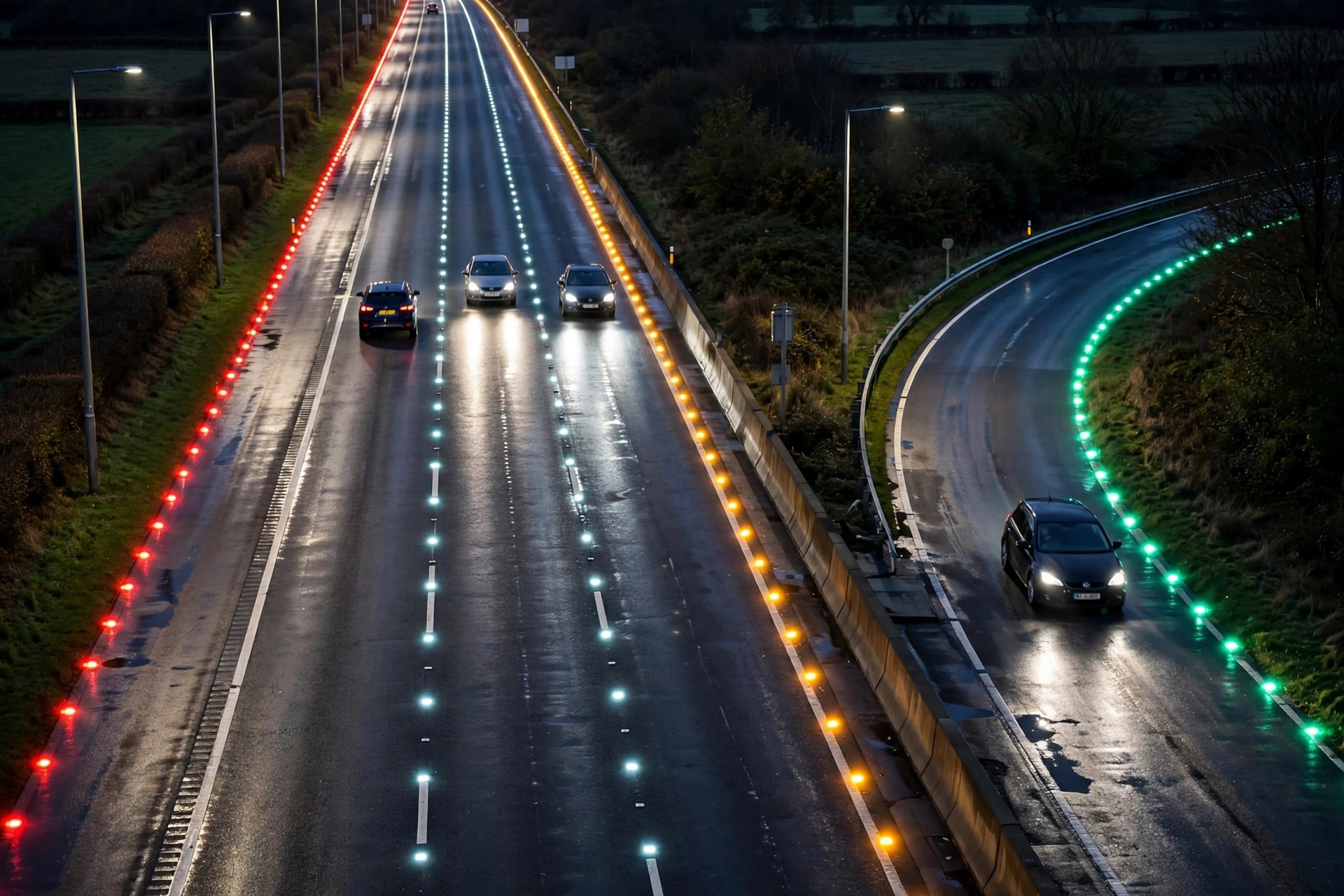
Amber reflective studs on a motorway mark the central reservation, and they are just one part of a colour code that every UK driver should know. The full code is set out in Rule 132 of The Highway Code, and it uses five colours to tell you where you are on the road, even at night, in the rain, or in thick fog when the painted lines have all but disappeared. White studs mark the lanes or the middle of the road, red studs mark the left-hand edge, amber studs mark the central reservation, green studs mark lay-bys and slip roads, and green and yellow studs mark temporary changes to the layout. Learn those five meanings, and you can read any motorway or dual carriageway in the country like a map.
What Are Reflective Road Studs?
Reflective road studs are small, tough blocks set into the surface of the road, and each one carries a reflective lens that bounces the light from your headlights back towards you, so the stud appears to glow even though it produces no light of its own. They are often called cat’s eyes, after the invention by Percy Shaw in the 1930s, and they have been a feature of British roads for nearly a century, because they solve a simple problem: painted lines are hard to see at night and almost invisible in the rain, while a raised reflective stud keeps shining through water, spray and darkness. The studs are spaced at regular intervals along the road, so a driver sees them as a dotted line stretching ahead, and that line gives a sense of where the road goes long before the headlights reach that far.
The studs are colour-coded so that the colour itself carries information, and that is what makes them so clever. A driver does not need to read a sign or study a diagram to understand them: the colour and the position together tell the whole story, and the code is the same on every road in the country. The system is maintained by highway authorities and set out in the official GOV.UK Highway Code, which is the authoritative source for the meanings in this guide. As of November 2026, the colour code in Rule 132 has not changed, so what you learn here will stay correct for years, and it is the same code that the driving theory test asks about.
What Do Amber Reflective Studs on a Motorway Mean?
Amber reflective studs on motorway mean that the central reservation is on that side of the road, and they run in a continuous line along the right-hand edge of each carriageway, directly beside the barrier or strip of grass that separates you from the traffic coming the other way. In short, amber reflective studs on motorway always mean the same thing: the central reservation is on that side of the road, and the amber line is the boundary you must not cross. If you are driving on a motorway at night and you can see a line of warm orange lights glowing on your right, those are the amber studs, and they are telling you exactly where the edge of your carriageway is. They are the most important studs to recognise on a motorway, because they mark the boundary between your direction of travel and the oncoming traffic, and that boundary is one you must never cross.
The amber line also gives you an instant sense of orientation, which is why the theory test asks about it so often. If the amber studs are on your right, you are on the correct carriageway and travelling in the right direction, because the central reservation always sits between you and the oncoming traffic, while if you ever found amber studs on your left, something would be badly wrong. The amber studs also help you judge the shape of the road ahead, because a line of evenly spaced lights gives your brain a rhythm to read, and any change in that rhythm tells you that the road is bending or rising. In an emergency, the amber studs help you judge where the edge of the road is so that you can pull over safely without hitting the barrier, and they help you describe your position to the emergency services.
What Do White Reflective Studs Mean?
White reflective studs mark the lanes or the middle of the road, and on a motorway you will see them in dotted lines between the lanes, telling you where one lane ends and the next begins. If you are driving in the middle lane of a three-lane motorway, you will have white studs on both sides of you, separating your lane from the lane on your left and the lane on your right, and that is how you know you are in the middle of the carriageway. On a single carriageway road, white studs mark the centre line, separating your side of the road from the traffic coming towards you, so the same colour does a slightly different job depending on the type of road.
White studs are the most common studs you will see, because every lane boundary on every motorway uses them, and they are the ones that help you most with lane discipline. If you find yourself drifting across the white studs without meaning to, it is a sign that you are tired or distracted, and you should take a break at the next services rather than carrying on. The white studs also help you in the rain, because painted lane markings can vanish under a sheet of water while the raised white studs keep shining, and that is why experienced drivers talk about following the studs rather than following the lines. Remember them simply: white means lanes, and if you can see white studs on both sides, you are in the middle of the road.
What Do Red Reflective Studs Mean?
Red reflective studs mark the left-hand edge of the road, and on a motorway they sit along the boundary beside the hard shoulder, so if you are driving in the left-hand lane, the red studs should always be on your left. Red is the colour of danger and of stopping, and that is a useful way to remember what the red studs mean, because the hard shoulder is the edge you should not cross except in a genuine emergency. Beyond the red studs lie the hard shoulder itself, where broken-down vehicles stop and where pedestrians may be walking, and crossing that line without good reason puts you and everyone else at risk.
The red studs are also a useful guide for judging your position in the left-hand lane, because if the red line is close on your left, you are near the edge of the carriageway, and if it is far away, you may be drifting towards the middle of the road. At night, the red studs are easy to spot because they glow a deep red in your headlights, and they are one of the first things a learner driver should look for when they join a motorway. If you ever see red studs on your right, you are on the wrong side of the road, and you should stop immediately in a safe place and call for help, because that is a sign of a serious error. The Driver and Vehicle Standards Agency tests the red stud meaning in the driving theory test, and its work is described on the GOV.UK DVSA pages.
What Do Green Reflective Studs Mean?
Green reflective studs mark the edge of the main carriageway at lay-bys and slip roads, and they are the only stud colour that signals a place where you are allowed to cross the edge marking. If you are driving on a motorway and you see a line of green studs appearing on your left, it means a slip road is coming up, and traffic will be leaving the motorway or joining it at that point, so you should be ready for vehicles to slow down, change lanes or appear from the slip road. If you see green studs marking a lay-by, it means you can pull in there to rest, and the green line shows you where the lay-by begins and ends.
Green is the colour of going, and that is a helpful way to remember what the green studs mean, because they mark the places where movement on and off the motorway is allowed. They are easy to miss if you are not looking for them, because slip roads and lay-bys are short, and the green studs only run for the length of the junction, so stay alert for the colour change and it will tell you that a junction is coming before the signs do. The green studs also matter for safety, because a vehicle joining the motorway from a slip road needs space to accelerate and merge, and a driver who has seen the green studs will be expecting that vehicle rather than being surprised by it.
What Do Green and Yellow Reflective Studs Mean?
Green and yellow reflective studs are fluorescent studs that mark temporary changes to the lane layout, usually where roadworks have created a contraflow or narrowed the carriageway, and they are the least common stud colour because they only appear where the road has been altered. When you see them, the normal layout no longer applies, and you should slow down, follow the signs, and expect the road to behave differently from usual, because the temporary studs override the permanent colours. In a contraflow, for example, you may be driving on the other side of the motorway, and the green and yellow studs will guide you through the altered lanes safely.
The fluorescent colour is deliberately bright and unusual, so that it catches your eye even when you are tired or distracted, and that is the point: temporary layouts are unfamiliar and therefore more dangerous, so the road needs to shout at you rather than whisper. If you are driving through a long stretch of roadworks at night, keep a steady speed, stay in your lane, and follow the green and yellow studs rather than the vehicle ahead, because the vehicle ahead may be just as lost as you are. The temporary studs are removed when the roadworks finish and the normal layout returns, so if you drive the same motorway a few weeks later, you will see the familiar red, white, amber and green pattern again.
How Can You Learn the Stud Colour Code for Your Theory Test?
Learning the stud colour code for your theory test is easier than it looks, because the whole code can be memorised as a single sentence: white for lanes, red for the left edge, amber for the central reservation, green for slip roads and lay-bys, and green and yellow for temporary layouts. Say that sentence a few times, and then picture a motorway from above and name the colours from left to right: red, white, white, amber, and you have just drawn the whole road in four words. It also helps to link each colour to something it already means in everyday life: red means danger and marks the hard shoulder, amber means caution and marks the central reservation, white is the colour of ordinary lane markings, and green means go and marks the places where traffic can enter and leave.
Practising with the theory test questions is the fastest way to lock the colours in, because the DVSA asks about them in several different ways and each question reinforces the same code. Try answering questions that show a diagram of a motorway and ask which colour marks the central reservation, which colour marks the left edge, and which colour marks a slip road, because those are the three questions that appear most often. It also helps to look for the studs on every drive, even as a passenger, because seeing them in real life is worth more than reading about them ten times, and once you have spotted amber studs glowing on your right on a dark motorway, you will never forget what they mean.
Conclusion
Amber reflective studs on motorway mark the central reservation, and they are one part of a simple, elegant colour code that keeps UK drivers safe after dark. White studs mark the lanes, red studs mark the left-hand edge beside the hard shoulder, amber studs mark the central reservation on the right, green studs mark the slip roads and lay-bys where traffic can enter and leave, and green and yellow studs warn you of temporary layouts in roadworks. That is the whole code, and it has not changed in years, because it works, and because every driver in the country learns the same five meanings.
The next time you drive on a motorway at night, take a moment to read the road the way it was designed to be read, and you will see the code working all around you. The amber line on your right tells you where the oncoming traffic is, the red line on your left tells you where the hard shoulder is, the white lines between the lanes keep you in your place, and the green studs warn you when a junction is coming. That knowledge costs nothing to learn and it stays with you for every drive you ever take, and it is one of the simplest ways to become a calmer, safer and more confident driver. If you want to keep up with what is happening on the motorways, our live updates on M3 accident and traffic news are a useful reminder of how quickly conditions can change, and why reading the road well matters every single time you drive.
FAQs
What do amber reflective studs mean on a motorway?
Amber reflective studs on motorway mark the central reservation, and they run along the right-hand edge of each carriageway, between the fastest lane and the barrier that separates you from the oncoming traffic. This is set out in Rule 132 of The Highway Code, which colour-codes all reflective road studs in the UK as of November 2026. On a typical three-lane motorway, you will see the amber line on your right whenever you are in the right-hand lane, and it stays in the same place on every motorway in the country.
What colour are the reflective studs between motorway lanes?
The reflective studs between motorway lanes are white. White studs mark the lanes or the middle of the road, so on a motorway you will see them in dotted lines between the lanes, telling you where one lane ends and the next begins. On a single carriageway road, white studs mark the centre line instead. The full colour code is set out in Rule 132 of The Highway Code, and it has not changed in years, so once you have learned it, you can rely on it on every road in the United Kingdom.
What colour studs mark the hard shoulder on a motorway?
Red reflective studs mark the left-hand edge of the carriageway beside the hard shoulder on a motorway. If you are driving in the left-hand lane, the red studs should always be on your left, and you should not cross them except in a genuine emergency, because beyond them lies the hard shoulder where broken-down vehicles may be stopped. If you are driving in the left-hand lane at night, the red studs should always be on your left, and if they are not, you should stop somewhere safe and check your position.
What colour studs mark a slip road on a motorway?
Green reflective studs mark the edge of the main carriageway at slip roads and lay-bys on a motorway. They show you where traffic can leave the motorway or join it, and where you can pull into a lay-by, and they are the only stud colour that signals a place where you are allowed to cross the edge marking. Green studs are easy to miss if you are not looking for them, because slip roads and lay-bys are short, so stay alert for the colour change as you approach a junction.
What are fluorescent green and yellow road studs for?
Fluorescent green and yellow road studs mark temporary changes to the lane layout, usually where roadworks have created a contraflow or narrowed the carriageway. When you see them, the normal layout no longer applies, so slow down, follow the signs, and expect the road to behave differently from usual until the roadworks end and the normal stud colours return. The fluorescent colour is deliberately bright and unusual so that it catches your eye, because temporary layouts are unfamiliar and therefore more dangerous than the normal road.


