
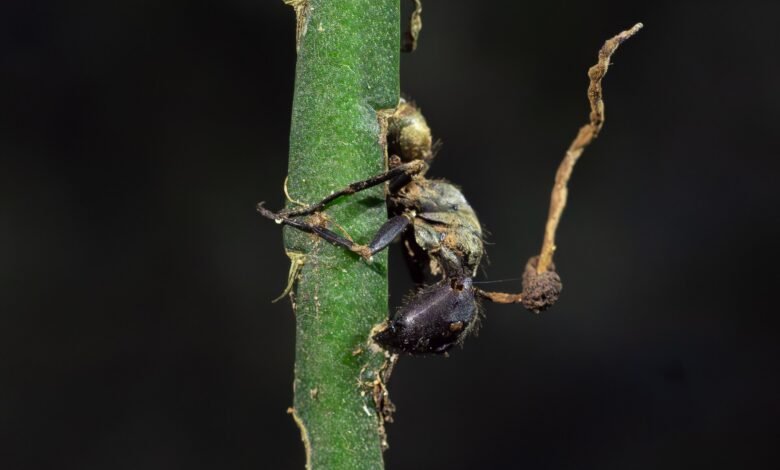
Zombie Ant Fungus: The Real Parasite Behind the Headlines
The zombie ant fungus is real, and it is every bit as disturbing as the television show suggests, except that its victims are ants rather than people. Known to science as Ophiocordyceps unilateralis, it is a parasitic fungus that infects carpenter ants and other insects, drains their bodies of nutrients, and steers their behaviour until they die in exactly the spot the fungus needs. The creators of The Last of Us did not invent this organism; they borrowed one of nature’s strangest parasites and asked what would happen if it ever learned to infect us.
That borrowing is the reason the show feels so unsettling, because the audience can sense that the horror is built on something genuine. The fungus really does turn its hosts into puppets, really does drive them to climb to a precise height, and really does sprout a spore-releasing stalk from the corpse afterwards. What the show changes is the host, the scale and the stakes. Understanding where the truth ends and the fiction begins makes the real story even more fascinating, because evolution has produced something stranger than any screenwriter would dare to invent from scratch.
Zombie Ant Fungus: How It Hijacks an Ant
The takeover begins quietly, when a spore from a dead infected ant lands on a foraging worker and pushes its way through the insect’s exoskeleton. Once inside, the zombie ant fungus multiplies and spreads thread-like cells through the body, feeding on soft tissues while the ant carries on walking, climbing and working as if nothing were wrong. For days the infection is almost invisible, which is part of its genius: the ant’s nestmates suspect nothing, and the fungus grows undisturbed while its host does the hard work of staying alive.
The control itself is more elegant than most people imagine. For years scientists assumed the fungus flooded the ant’s brain with chemicals, but detailed research has shown that the brain stays largely intact and almost free of fungal cells. Instead, the fungus wraps itself around the muscle fibres, especially in the legs and the jaw, and steers the body chemically from the outside, like a puppeteer working strings. It also appears to alter genes linked to the ant’s nervous system and biological clock, which explains the eerily precise timing of the final act: the infected ant climbs to a low leaf, clamps its jaws onto a vein in a death grip it can never release, and dies exactly where the humidity suits the fungus.
Zombie Ant Fungus: What The Last of Us Changed
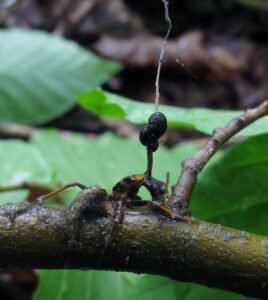
The Last of Us keeps the central idea, a fungus that hijacks its host, and changes almost everything else. In the show, the fungus spreads between people, turns them into violent infected creatures, and connects them through a vast underground network. In reality, the real fungus does none of those things. It does not spread from ant to ant through bites or contact; new victims are infected by spores that rain down from corpses hanging above their foraging trails. The infected are not connected to one another, and they do not attack anything. They climb, they bite, and they die.
The show also compresses the timescale and raises the temperature problem out of existence. A real infection takes roughly a week or two to run its course, and the fungus is exquisitely tuned to one kind of host. The fictional version jumps to humans in a single leap, which makes for superb television and terrible biology. Scientific American’s fact-check of the show’s fungus puts it bluntly: there is zero correlation between this fungus and human infection, and no Ophiocordyceps species invades any fish, amphibian or mammal. The show is brilliant storytelling built on a real organism, but it is storytelling, not a forecast.
Zombie Ant Fungus: Why Humans Are Safe
The reason humans are safe from the zombie ant fungus is beautifully simple: we run far too hot. Insects are cold-blooded, and the fungus has spent millions of years evolving to thrive at the low body temperatures of ants. Human bodies run at around 37 degrees Celsius, and at that temperature the proteins of most such organisms simply denature, meaning the fungus cannot survive inside us, let alone grow, spread or manipulate anything. Our advanced immune systems add a second wall of defence, and the sheer chemical distance between an ant’s body and a person’s body is a third.
It is worth adding that this safety is specific, not universal. Fungi in general are not harmless to people, and scientists do watch for fungal pathogens that are adapting to warmer temperatures as the climate changes. The honest scientific position is that a human pandemic from this fungus itself is not plausible, while the broader world of fungi deserves the same serious attention as bacteria and viruses. That distinction matters, because it lets us enjoy the horror of the story without misunderstanding the science, and it keeps the real research focused on the fungal threats that genuinely exist.
Zombie Ant Fungus: What Science Still Does Not Know
For all that scientists have learned, the zombie ant fungus still guards real mysteries. Researchers are not entirely sure how the fungus exerts such precise control, and the leading theories combine physical manipulation of muscle fibres with a chemical attack on the host, using small molecules or proteins that alter brain behaviour from outside the brain itself. The exact cocktail of compounds, and how they interact with the ant’s nervous system, remains an active area of research, and each new study seems to reveal another layer of sophistication.
There are also open questions about the wider ecosystem. Ant colonies fight back with social immunity, detecting and removing infected workers before the fungus can mature, while specialised hyperparasitic fungi attack the fungus itself, crippling its ability to release spores. Just as genes shape how plants develop, genetics shape the behaviour of living things in ways that parasites have learned to exploit over millions of years. The result is an arms race stacked in layers, refined over tens of millions of years, and still running in forests around the world today.
Zombie Ant Fungus: Why the Story Fascinates Us
The zombie ant fungus fascinates us because it asks a question that horror fiction has chewed on for a century: who is really in control of a living body? Here is a parasite that leaves the brain untouched and simply takes over the muscles, the timing and the chemistry around it, and the ant walks to its own death believing, in whatever sense an ant believes, that it is following its own instincts. That is a more unsettling idea than any monster, because it suggests that free will can be an illusion maintained by machinery that someone else can learn to operate.
The Last of Us succeeded because it took that idea and aimed it at us. The show asks what would happen if the puppet strings were attached to people instead of ants, and the answer is a collapsed civilisation. The real story is quieter and, in its own way, more impressive: a tiny fungus, working without a brain of its own, has been steering ants for at least forty-eight million years. NPR’s reporting on the real fungus behind the show captures the balance well: the organism is genuinely astonishing, and genuinely unable to hurt us. We can admire the horror from a safe distance, which is exactly where it belongs.
Frequently Asked Questions
What exactly is the zombie ant fungus? It is a parasitic fungus called Ophiocordyceps unilateralis that infects carpenter ants and other insects, grows through their bodies, manipulates their behaviour so they climb and bite onto vegetation, and then sprouts a spore-releasing stalk from the dead ant’s head. Fossil evidence suggests this behaviour is at least forty-eight million years old, making it one of the oldest and most refined examples of a parasite controlling its host. It cannot infect humans, pets or any warm-blooded animal.
Could the zombie ant fungus ever infect humans? No, not plausibly. The fungus is an extreme specialist, fine-tuned over millions of years to the body chemistry and low temperature of particular ants, and it cannot survive human body temperature. Scientists are clear that a human pandemic from this fungus is not a realistic prospect, because too many biological barriers stand in the way, from temperature to immune systems to the sheer chemical distance between an ant and a person. The idea of it jumping to people comes from The Last of Us, which borrowed the fungus as inspiration for fiction.
Final Thoughts
The zombie ant fungus endures as one of biology’s great stories because it overturns our assumptions at every turn. We imagine mind control as an invader seizing the brain, yet here is a parasite that leaves the brain untouched and simply takes over the muscles, the timing and the chemistry around it. We imagine the ant as a helpless victim, yet its colony runs a detection-and-quarantine system effective enough to keep the fungus in check, while the fungus itself is hunted by parasites of its own. Every layer of the story contains another, older layer underneath it.
Perhaps that is why this tiny tropical fungus has travelled so far beyond the forest, into games and television shows watched by millions. It speaks to a deep human fascination with the question of who is really in control of a living body, and it answers with unsettling elegance: sometimes, not the owner. The good news is that the horror stays where it belongs, in the ant world, a few centimetres above the forest floor. For us, it remains pure wonder, a reminder that evolution’s strangest inventions are usually already out there, quietly at work, long before we think to imagine them.
