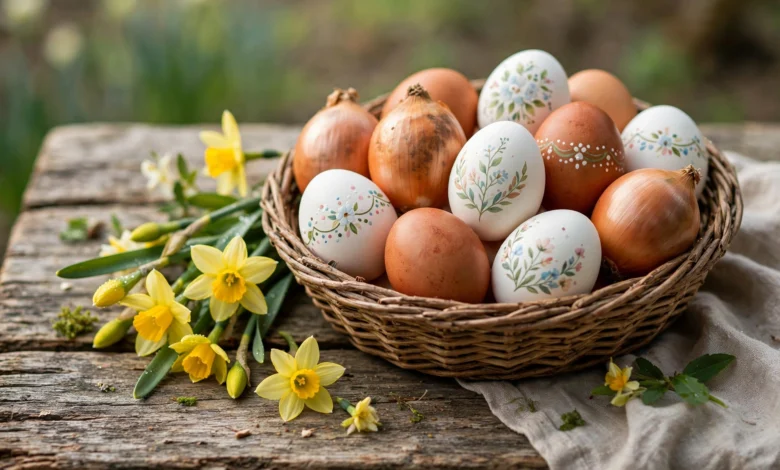
Easter is the central festival of Christianity, celebrating the resurrection of Jesus Christ on the third day after his crucifixion, and its best-known traditions — Holy Week services after Lent, decorated and chocolate eggs, the Easter Bunny, hot cross buns, egg hunts and roast lamb — grew up around that story over many centuries. In the UK, Easter combines solemn observances such as Good Friday and Royal Maundy with a long spring weekend of family food and egg hunts. The next Easter Sunday falls on 28 March 2027.


At a Glance
- What Easter celebrates: The resurrection of Jesus Christ, three days after his crucifixion on Good Friday, according to Christian belief (Encyclopaedia Britannica).
- Next Easter Sunday: Sunday, 28 March 2027 — Good Friday is 26 March 2027 and Easter Monday is 29 March 2027 (timeanddate).
- Why the date moves: Easter is the first Sunday after the first full moon on or after 21 March, a rule linked to the Council of Nicaea in 325, so it can fall between 22 March and 25 April (Encyclopaedia Britannica).
- Preparation: Lent — 40 days not counting Sundays, from Ash Wednesday to Easter Eve — a season of reflection, prayer and giving things up (Church of England).
- Key symbols: The egg (new life), the lamb (sacrifice and Passover), the hot cross bun, and the egg-laying Easter Hare from Germany.
- UK highlights: The Royal Maundy service, pace eggs and pace egg plays in northern England, and egg rolling at Avenham Park, Preston.
Easter is not the only major festival whose date moves with a lunar calendar — our guide to when Diwali falls in 2026 explains that festival’s dates and five days of celebrations the same way.
When Is Easter, and Why Does the Date Change Every Year?
Easter is a moveable feast, worked out from the Moon as well as the Sun. According to Encyclopaedia Britannica’s article on Easter, the Council of Nicaea in 325 decreed that Easter should be kept on the first Sunday following the first full moon after the spring equinox, fixed at 21 March. So, as of October 2026, Easter Sunday can fall between 22 March and 25 April in western churches.
For the next Easter, that gives Palm Sunday on 21 March 2027, Maundy Thursday on 25 March, Good Friday on 26 March, Easter Sunday on 28 March 2027 and Easter Monday on 29 March. Orthodox churches often celebrate later: Britannica notes their calculation uses the Julian calendar, and Orthodox Easter must also follow Passover. In England and Wales, Good Friday and Easter Monday are bank holidays, creating a four-day weekend.
Where Does the Word “Easter” Come From?
In most European languages the festival is named from Pascha, linked to the Hebrew Pesach, or Passover — hence Pâques in French and Pascua in Spanish. English and German, with Easter and Ostern, are the unusual cases.
One famous explanation comes from the Venerable Bede, the 8th-century Northumbrian monk, who wrote that the Old English month roughly corresponding to April, Ēosturmōnaþ, was once named after a goddess called Ēostre, in whose honour feasts were held.
That passage is important — and limited. Bede is the only known early source who names Ēostre at all, and no surviving record of her worship backs it up. Later writers expanded the idea, notably Jacob Grimm in the 19th century, who reconstructed a continental form, Ostara.
Britannica, as of October 2026, describes the word’s origin as uncertain, noting an alternative: that it developed from in albis, the Latin designation for Easter week, linked to alba, meaning dawn, which became eostarum in Old High German.
So a link to Ēostre is possible and rests on Bede — but claims that eggs, hares or buns were handed down from a documented Ēostre cult go beyond the evidence.
What Happens During Lent and Holy Week?
For practising Christians, Easter starts about six weeks earlier, with Lent. The Church of England’s guide to Lent, Holy Week and Easter describes Lent as lasting 40 days, not including Sundays, beginning on Ash Wednesday — a time of self-examination, prayer, giving and self-denial, recalling the 40 days Christians believe Jesus spent fasting in the wilderness.
Shrove Tuesday was historically when eggs, milk and fat were used up before the fast — the origin of Pancake Day in Britain. On Ash Wednesday, churches mark foreheads with ash, traditionally from the previous year’s palm crosses.
Palm Sunday, Maundy Thursday and Good Friday
Holy Week begins on Palm Sunday, recalling Jesus’s entry into Jerusalem, when crowds waved palm branches. Churches commonly distribute small palm crosses and sometimes hold processions.
Maundy Thursday remembers the Last Supper. Its name comes from the Latin mandatum — a command — referring to Jesus’s command to love one another. At that meal he washed his disciples’ feet, and some churches still include foot-washing as a symbol of humble service.
Good Friday commemorates the crucifixion. Services are sombre, and in many British towns churches join a Walk of Witness through local streets. For many Christians it is a day of fasting or abstinence from meat.
Holy Saturday and Easter Sunday
Holy Saturday is a day of waiting. In the evening, many churches hold an Easter Vigil: the service begins in darkness, a fire is lit, and a large Paschal candle is carried in, from which congregants light their own candles.
Easter Sunday reverses the mood. Churches fill with flowers and hymns, and “Christ is risen” is answered, “He is risen indeed” — in Greek, Christos Anesti and Alithos Anesti. The Church of England notes that Easter Day begins a 50-day season running to Pentecost.
Why Do We Give Easter Eggs?
The Church of England explains that Easter eggs represent new life, and that some people also see the shell as resembling the stone at the entrance to Jesus’s tomb, rolled away on Easter morning.
There was a practical reason, too. In medieval western Christianity, eggs were given up during Lent. Hens kept laying, so eggs were hard-boiled to preserve them, decorated, and eaten or given away when the fast ended.
Decorated-egg traditions go far beyond painted shells:
- Pysanky in Ukraine: A pysanka is decorated by “writing” designs in hot beeswax with a stylus called a kistka, dyeing the egg, then adding more wax and darker dyes in stages — a wax-resist method similar to batik. The Canadian Museum of History notes that pysanky have been part of Ukrainian heritage for centuries, and that after Christianity spread in the region from around the 10th century, the designs took on Easter meanings as well. The Pysanka Museum in Kolomyia holds more than 10,000 pysanky.
- Red eggs in Greece: Greek families dye eggs red on Holy Thursday — the red symbolising, within the tradition, the blood of Christ. After the midnight service, players crack eggs against each other’s in tsougrisma; the person whose egg survives is said to have good luck.
Who Is the Easter Bunny?
The Easter Bunny began as an Easter Hare. Georg Franck von Franckenau’s De ovis paschalibus (“About Easter Eggs”, 1682) described a German belief in a hare that laid eggs hidden in gardens for children to find.
In German Lutheran tradition, the Osterhase also judged whether children had behaved well — a role compared to Father Christmas’s naughty-or-nice list. Children made nests in caps or bonnets for its coloured eggs.
German immigrants carried the idea to the United States in the 1700s, particularly to Pennsylvania Dutch country. Over time the hare became a rabbit in English, nests became baskets, and real eggs were joined by chocolate and sweets.
Claims linking the Easter Bunny directly to Ēostre’s hare are popular, but are not documented in Bede or the early German sources. Hares were long-standing spring symbols, which makes a connection plausible background — not a proven line of descent.
What Are Egg Hunts and Egg Rolling?
An egg hunt hides decorated, chocolate or plastic eggs for children to find — the modern form of searching for eggs the Easter Hare was said to have hidden.
Egg rolling is older and simpler: hard-boiled decorated eggs are rolled down a grassy slope, as a race or to see whose egg survives intact. Avenham Park in Preston is a well-known venue for Easter Monday rolling. The idea that the rolling egg represents the stone rolled from the tomb is a later symbolic interpretation, not a documented origin.
The most famous egg roll is in the United States. The White House states that its Easter Egg Roll officially dates to 1878, under President Rutherford B. Hayes: after Congress restricted egg rolling on the Capitol grounds, Hayes allowed children to use the White House grounds instead. It still takes place on Easter Monday on the South Lawn.

What Foods Are Traditional at Easter?
Why do we eat hot cross buns?
A hot cross bun is a spiced, fruited bun marked with a cross, traditionally eaten on Good Friday in Britain, Ireland and the Commonwealth.
Its exact origin is not settled. Stories about a medieval monk inventing the bun are widely repeated, but hard evidence is thin. Spiced buns were established as a Good Friday food in England by the early modern period, and a regulation under Elizabeth I in 1592, restricting the sale of spiced buns to Good Friday, Christmas and funerals, is frequently cited by food historians as evidence of that link. Claims that the bun descends directly from pagan cakes are speculation, not a documented recipe history.
Why is lamb eaten at Easter?
Roast lamb, the classic Easter Sunday lunch in Britain, Greece and much of Europe, has two reinforcing roots. The first is Passover: in the Book of Exodus, a lamb was sacrificed and eaten at the first Passover. The second is Christian teaching: in the Gospel of John, Jesus is called the “Lamb of God”. Lamb is also a natural spring food. In Greece, a whole lamb is commonly spit-roasted on Easter Sunday, after the midnight feast that breaks the fast.
Which Easter Traditions Are Distinctly British?
The Royal Maundy service
Royal Maundy is Britain’s most distinctive Easter ceremony. According to the Royal Family, every Maundy Thursday the monarch distributes special Maundy money at a service in a different cathedral or abbey each year, commemorating Jesus washing the apostles’ feet.
Recipients are pensioners chosen for outstanding Christian service, and their number matches the sovereign’s age: in 2023, the Royal Family’s site records, King Charles III presented Maundy money at York Minster to 74 men and 74 women.
Each recipient receives two leather purses: a red purse with ordinary coinage symbolising the gift of food and clothing, and a white purse with silver Maundy coins, in 1p, 2p, 3p and 4p denominations, to the value of the sovereign’s age. The coins are legal tender, but recipients almost always keep them. Medieval monarchs also washed the feet of poor people on Maundy Thursday; that element did not survive the 18th century, but the giving did.
Pace eggs and pace egg plays
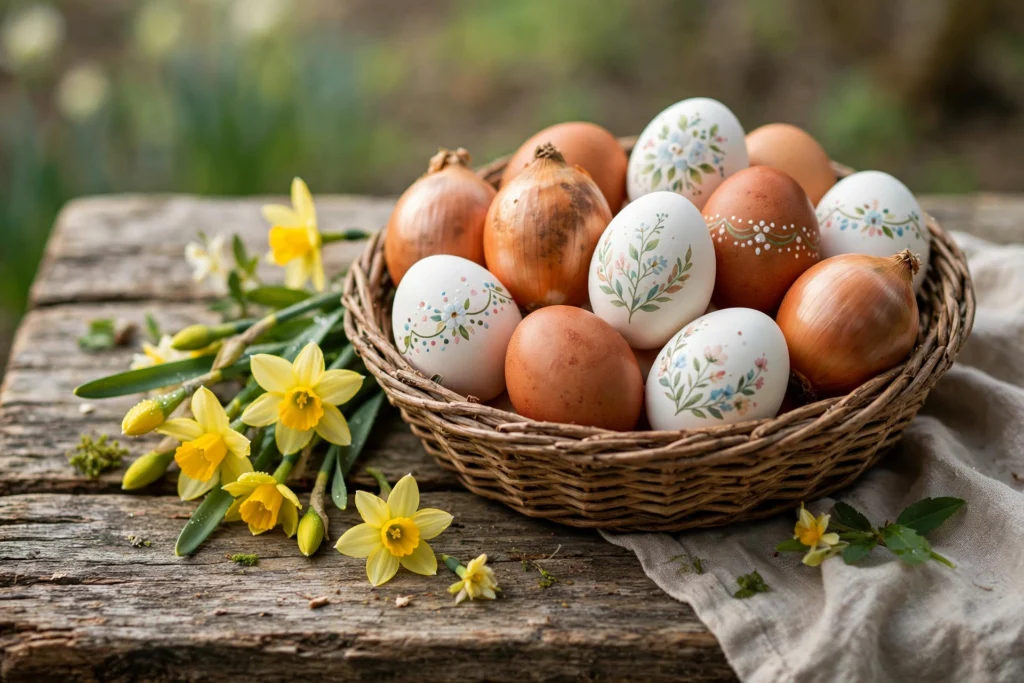
Pace comes from Pasch or Paschal — Easter. In northern England, pace eggs were hard-boiled eggs dyed — often boiled in onion skins for a mottled gold pattern — then given as gifts, eaten, rolled, or cracked against an opponent’s egg.
Linked to them were pace egg plays, performed by troupes of pace eggers in decorated costumes, who went from house to house and were rewarded with eggs or money. They follow the mummers’ pattern — a hero, often St George, is killed in mock combat and brought back to life by a comic Doctor. Warrington Museum and Art Gallery records that the plays were once common across northern England, largely died out after the First World War, and were revived in parts of Lancashire and West Yorkshire in the 20th century. Heptonstall’s play remains the best-known example.

How Is Easter Celebrated Around the World?
Spain — Semana Santa. In Seville and across Andalusia, brotherhoods, the hermandades and cofradías, carry pasos — heavy platforms bearing lifelike wooden sculptures of Christ and the Virgin Mary — from their home churches to the cathedral and back, a journey of many hours. Penitents walk in robes and tall pointed hoods, capirote, which historically allowed anonymous repentance. The peak is la madrugada, the night from Maundy Thursday into Good Friday.
Greece — midnight Anastasi and red eggs. At the Anastasi service late on Holy Saturday, the church is darkened, the resurrection is announced at midnight, and candles are lit from a single flame and passed through the congregation. Families then break the fast, traditionally with magiritsa soup, before Sunday’s spit-roasted lamb.
Poland — Śmigus-Dyngus, or Wet Monday. On Easter Monday, Lany Poniedziałek, people splash each other with water — from a sprinkle to a full water fight. Ethnologists at the State Ethnographic Museum in Warsaw trace the custom in Poland to at least the 14th century, as two merged rites: śmigus, tapping with willow branches, and dyngus, dousing with water, both linked to spring purification. Visitors on Easter Monday should expect to get wet.
Frequently Asked Questions
When is Easter 2027?
Easter Sunday is on 28 March 2027, Good Friday on 26 March and Easter Monday on 29 March (timeanddate).
Why does Easter change date every year?
Easter follows a lunar rule linked to the Council of Nicaea in 325: the first Sunday after the first full moon on or after 21 March. So it moves between 22 March and 25 April (Encyclopaedia Britannica).
Why do we have Easter eggs?
Eggs symbolise new life; the shell is also compared to the stone of Jesus’s tomb. Eggs were given up during Lent in medieval western Christianity, preserved by hard-boiling, decorated, and given as gifts when the fast ended. Fry’s made the first hollow moulded chocolate egg in Britain in 1873 (Guinness World Records).
Where did the Easter Bunny come from?
From Germany. An egg-laying Easter Hare is described in German sources by 1682, in Georg Franck von Franckenau’s work on Easter eggs. German immigrants took the Osterhase to Pennsylvania in the 1700s, where it became the Easter Bunny.
What is the Royal Maundy service?
A Maundy Thursday service at which the British monarch gives specially minted silver Maundy money, in red and white purses, to pensioners chosen for service to their church and community. The number of recipients matches the sovereign’s age (the Royal Family).
Is Easter really named after a pagan goddess?
Possibly, but it is not proven. Bede said the Old English month Ēosturmōnaþ was named after a goddess called Ēostre. He is the only early source for her, and Britannica describes the word’s origin as uncertain.
Sources: Encyclopaedia Britannica, the Church of England, the Royal Family, the White House, Guinness World Records, the Canadian Museum of History, Warrington Museum and Art Gallery, and timeanddate — as of October 2026.