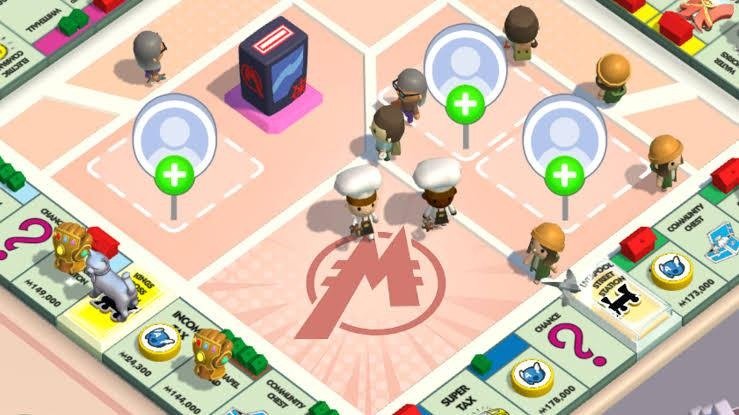
Monopoly Go Partner Events are a recurring, limited-time event system, with new events launched approximately every twenty days based on collaborations or holidays. For example, during its recent collaboration with The Simpsons, two Partner Events were launched – Simpsons Partners and Springfield Partners.
As a game that emphasizes social interaction, Partner Events should be its most attractive cooperative gameplay element – with players teaming up to collect tokens, complete construction goals, and earn limited-time rewards.
However, with the increasing difficulty and complexity of the events, this gameplay is evolving from a fun and cooperative experience into a controversial social experiment. The controversy surrounding Partner Events is tearing apart the player community and putting the developers under intense scrutiny. Today, EZG.com will provide an in-depth analysis of this phenomenon.
Imbalanced Mechanisms
The core of the controversy surrounding Partner Events lies in the inherent imbalance in the game’s mechanics. Many veteran players have complained that Monopoly Go Partner Events have transformed from a once enjoyable and rewarding experience into an almost impossible ordeal.
One player commented bluntly in a community forum post: “Partner Events used to be fun, but now it’s practically impossible to complete. Spending 15,000 dice to complete an event and only getting 5,000 dice in return is simply not worth it.”
Further fueling player dissatisfaction is that the remaining tokens after the event are only exchanged for cash instead of the more universally accepted Monopoly Go dice, exacerbating the feeling of wasted resources.
EZG.com believes that the design of these events is essentially a carefully crafted micro-transaction monopoly. When players are forced to consume a large number of dice to complete an event, and then face the temptation to recharge after their dice reserves are depleted, the event itself becomes a tool for forcing players to spend money.
Monopoly Go and The Simpsons collaboration has further exacerbated this situation. Players not only need to collect all 189 Monopoly Go stickers in the main album, but also four additional episode sets. For free players, completing the sticker sets is already an unattainable goal, and the new partner events constantly deprive us of dice and event items, forcing us to spend even more money.
Social Pain
If the controversy surrounding the mechanics was a conflict between players and developers, then the social controversy sparked by the partner event was the most direct emotional clash between players.
Teammates Slacking Off
Monopoly Go Partner Events require players to invite friends to team up and complete building objectives together. However, when one person fully commits and contributes tens of thousands of points, while the other’s contribution remains stagnant, the game ceases to be a game.
EZG.com believes it’s not an exaggeration to describe this phenomenon as a social experiment: event invitations can escalate into silent resentment. When you see your partner’s contribution points at zero, while you’ve already invested tens of thousands, the game turns into a personal feud.
Even more frustrating for players is that Monopoly Go currently lacks any mechanism to remove inactive partners. Choosing the wrong teammates means bearing all the pressure alone, or watching the entire project fail.
The Rise of Carry Culture
Accompanying the phenomenon of slackers is the prevalence of carry culture. Carry players are the backbone of Monopoly Go Partner Events; they typically have substantial inventory resources and can unlock all rewards for the entire team single-handedly.
However, this culture also brings new problems. On one hand, it exacerbates the game’s inequality – ordinary players can hardly complete high-difficulty events without a carry. On the other hand, the demand for carry has led to a surge in boosting services, and the risk of scams has increased dramatically.
If you’re also looking for reliable carry teammates to complete events quickly and efficiently with minimal effort, then don’t hesitate! You can buy Monopoly Go Partner Event slots at EZG.com, where professional players are always ready to assist you, so you’ll never have to worry about being held back by lazy teammates again.
Accusations Against the Officials
The third controversy surrounding Partner Events centers on the developer’s response strategy – from bug fixing to player punishment, every step has sparked heated debate.
During last year’s Jedi Partner, a loophole allowing players to obtain a high number of points for free was discovered and quickly spread by players. Subsequently, the official team directly issued permanent bans to players who exploited the loophole.
This tough stance elicited drastically different reactions within the player community. Some players showed no remorse for exploiting the loophole, believing it was simply a legitimate use of the game mechanics. Others blamed the developers, arguing that the excessive difficulty of the event was the root cause of players taking the risk. This vicious cycle of “the official team creating problems – players finding solutions – the official team punishing players” has continuously deteriorated the trust relationship between developers and players.
The Deeper Logic Behind the Controversy
The three controversies surrounding Monopoly Go Partner Events – mechanics, social interaction, and the official team – are not isolated but intertwined and mutually reinforcing.
The imbalance in the game mechanics has fostered a carry culture. When ordinary players cannot complete events on their own, finding a carry becomes the only way out. This carry culture amplifies social conflicts – the unequal relationship between the carried player and the hard-working player turns Partner Events from a collaboration into a transaction.
As of today, Monopoly Go’s The Simpsons collaboration season is still ongoing. However, if the developers fail to address players’ reasonable demands for a fair game mechanic and a positive social experience, Partner Events, this core gameplay element, will likely continue to slide into an abyss of controversy.
EZG.com believes that when a game marketed as casual makes players feel cheated, betrayed, and exploited, it loses not only players’ wallets but also their trust and passion – this may be the biggest crisis.