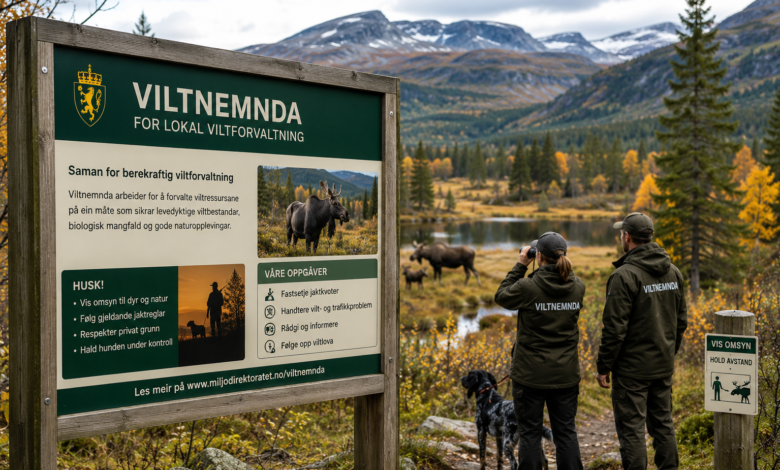
Norway has one of the most structured wildlife management systems in the world, built to balance conservation, hunting, and human activity. At the centre of this system is the Wildlife Act (Viltloven), supported by local governance bodies known as Viltnemnda. Together, they regulate hunting, protect biodiversity, and manage wildlife populations using scientific and legal frameworks.

The system is based on data-driven decision-making, where wildlife populations are continuously monitored through field reports, surveys, and environmental data. It ensures that hunting is only permitted when populations are stable and ecologically sustainable.Modern wildlife management in Norway also integrates technology such as digital reporting systems, GPS tracking, and population modelling to improve accuracy in decision-making.
What is Viltnemnda
Viltnemnda is a municipal wildlife committee responsible for local wildlife management in Norway. It operates at the municipal level and works under national environmental laws.
Its main responsibilities include monitoring wildlife populations, assessing local conditions, recommending hunting quotas, and managing wildlife-related conflicts between humans and animals.Viltnemnda does not function as a national authority and does not have final legal decision-making power. Instead, it acts as a local advisory and implementation body within the broader Norwegian wildlife governance system.
Wildlife Act Norway Overview
The Wildlife Act is the main legal framework regulating wildlife conservation and hunting in Norway. Its core principle is that all wild animals are protected unless specific permission for hunting is granted by law.
The Act governs hunting seasons, species protection, trapping regulations, firearm usage, and sustainable wildlife harvesting. It ensures that wildlife populations are maintained at ecologically stable levels while allowing controlled hunting activities.The law is designed to support long-term biodiversity conservation while balancing economic, agricultural, and recreational interests.
Wildlife Governance Structure in Norway
Wildlife management in Norway operates through a three-level governance system:At the national level, the Norwegian Environment Agency sets policies, legal frameworks, and national guidelines.
At the regional level, County Governors oversee implementation, approve quotas, and ensure compliance with national regulations.At the local level, Viltnemnda collects data, evaluates local conditions, and proposes wildlife management decisions.Final approval of major decisions such as hunting quotas typically rests with regional authorities rather than local committees.
How Hunting Quotas Are Decided
Hunting quotas in Norway are based on a structured scientific process rather than arbitrary decisions.The process begins with wildlife data collection, which includes population surveys, forestry damage reports, road accident statistics, and hunter field reports.Viltnemnda then evaluates this data at the municipal level and prepares quota recommendations based on ecological balance and local conditions.
These recommendations are reviewed by the County Governor, who may adjust them based on regional sustainability targets.Final quotas are published before the hunting season begins, ensuring regulated and controlled harvesting.
Emergency Wildlife Management System
Norway has a structured system for handling wildlife emergencies such as dangerous animal behaviour, road accidents, and disease outbreaks.In such situations, the police are usually the first responders. Viltnemnda coordinates local response efforts, while certified hunters may be called to assist in tracking or removing injured animals.The Norwegian Environment Agency provides final oversight in complex or high-risk situations.
This system ensures rapid response while maintaining legal and ethical wildlife handling standards
Wildlife Conflict and Compensation System
When wildlife causes damage to agriculture or property, Norway operates a formal compensation and verification system.
Farmers report damage to municipal authorities, after which Viltnemnda assesses and verifies the incident. Inspections are conducted to confirm the extent of damage and determine eligibility for compensation.Common conflicts include crop damage caused by moose and deer or livestock attacks from predators in rural areas. Approved claims are compensated through government-managed systems.
Technology in Wildlife Management
Modern wildlife management in Norway increasingly relies on advanced technology to improve accuracy and efficiency.
GPS tracking systems are used to monitor animal movement patterns. Drone surveillance helps estimate population sizes in remote areas. Artificial intelligence tools are increasingly used to analyse wildlife data and predict population trends.Digital hunter registries allow authorities to track hunting activity in real time and improve compliance with regulations.
Wildlife Data Collection and Verification
Wildlife management decisions are based on multiple independent data sources.These include hunter reports submitted after hunting seasons, forestry department observations, roadkill records, and field monitoring data.
To ensure accuracy, all data is cross-verified using statistical models and seasonal correction methods. This reduces errors and improves the reliability of hunting quotas and conservation strategies.
Science Based Wildlife Decision Making
Wildlife management decisions in Norway are primarily science-driven. Population biology, migration patterns, and ecosystem balance are key scientific factors used in decision-making.Administrative authorities then review these scientific recommendations to ensure they align with regional policies, public needs, and legal frameworks.This combination ensures that decisions are both scientifically valid and socially acceptable.
In addition, long-term monitoring data is used to track changes in wildlife populations over time.This helps authorities adjust policies based on seasonal and yearly environmental variations.It also reduces the risk of overpopulation or ecological imbalance.
Why Hunting Seasons Are Strictly Regulated
Hunting seasons in Norway are carefully designed based on biological and ecological principles.Key factors include breeding cycles, migration patterns, winter survival rates, food availability, and climate conditions. These factors ensure that hunting only targets surplus populations and does not disrupt ecological balance.Seasonal regulations are updated regularly to reflect environmental changes.
Authorities also ensure that hunting does not interfere with reproduction periods or juvenile survival rates.Different regions may have slightly adjusted seasons depending on local ecological conditions.This makes the system highly adaptive and region-specific.
Enforcement of Wildlife Laws
Wildlife law enforcement in Norway involves multiple agencies, including police authorities, environmental crime units, and national inspection services.Enforcement methods include field inspections, digital monitoring systems, public reporting, and hunter compliance tracking.Violations such as illegal hunting, exceeding quotas, or hunting without permission can result in fines, confiscation of equipment, suspension of hunting rights, and in serious cases, imprisonment.
Enforcement is supported by strict documentation requirements for all licensed hunters in the field.Authorities also use cross-checking systems between hunting reports and quota allocations to detect irregularities.This ensures high compliance and reduces illegal hunting activities.
Public Participation in Wildlife Management
Public participation plays an important role in Norway’s wildlife governance system.
Citizens can report wildlife damage, attend municipal meetings, participate in consultations, and submit formal complaints regarding wildlife issues.This system ensures that local communities have input in wildlife management decisions and helps maintain transparency.
Public feedback is often considered during quota planning and environmental assessments.
Local knowledge from farmers and hunters contributes valuable real-world data to official decision-making.This participatory model strengthens trust between authorities and communities.
Funding and Financial Structure
Wildlife management in Norway is funded through hunting license fees, government budgets, and municipal allocations.These funds are used for wildlife monitoring, compensation payments, enforcement operations, research programs, and conservation initiatives.
A significant portion of funding is reinvested into field research and ecological monitoring systems.Administrative costs are distributed between national and local authorities depending on responsibility levels.This ensures sustainable financing for long-term wildlife conservation efforts.
Real Wildlife Law Cases in Norway
Several enforcement cases highlight the strict nature of Norwegian wildlife laws.In one case, moose hunting outside the allocated quota area resulted in fines and temporary hunting bans. In another case, illegal wolf hunting led to imprisonment and permanent loss of hunting rights. Disease control operations have also required emergency reductions in wildlife populations to prevent ecological damage.
These cases demonstrate that enforcement is consistent and legally strict across all regions.
They also show that violations are treated seriously regardless of intent or scale.This strong enforcement framework supports sustainable wildlife management nationwide.
Conclusion
The Wildlife Act and Viltnemnda system represent a highly structured and science-based approach to wildlife governance. By combining local management, national regulation, modern technology, and strict enforcement, Norway ensures long-term biodiversity conservation while allowing controlled hunting activities.
This system is widely regarded as one of the most advanced wildlife management models in the world due to its balance between ecological protection and sustainable resource use.
FAQs
Who has final authority in wildlife management in Norway?
Final authority lies with the County Governor and the Norwegian Environment Agency, while Viltnemnda handles local implementation and recommendations.
Can hunting quotas be changed during the season?
Yes, but only in exceptional cases such as disease outbreaks or ecological emergencies.
Who collects wildlife data in Norway?
Data is collected from hunters, forestry departments, field rangers, and government monitoring systems.
Does Viltnemnda enforce wildlife laws?
No. Enforcement is handled by police and environmental inspection authorities.
Can tourists hunt in Norway?
Yes, but only with proper registration, permits, and landowner permission.
Why is Norway’s Wildlife Act strict?
It is designed to ensure sustainable wildlife populations and prevent ecological imbalance.