Foot Pain and Exercise — What Active Adults Often Get Wrong About Plantar Fasciitis, Achilles Tendinopathy, and Bunions

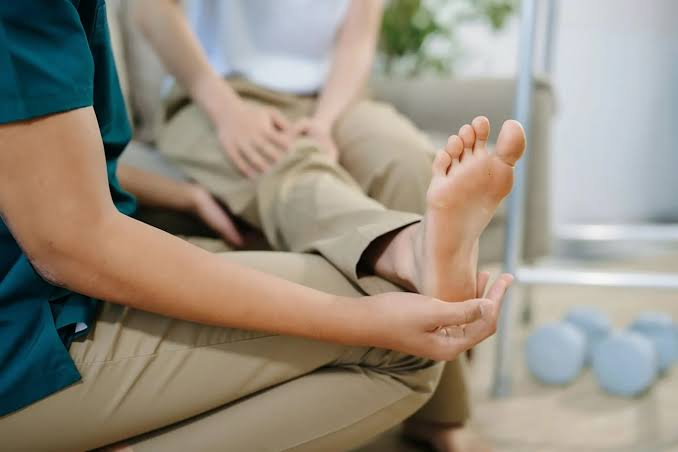
Runners and generally active adults tend to develop a particular set of foot and ankle problems more often than the rest of the population, and they also tend to make a particular pair of mistakes when those problems show up: either pushing straight through the pain because stopping training feels like losing progress, or going to the opposite extreme and resting completely until the pain disappears. With degenerative tendon and fascia conditions, both instincts are usually wrong, just in different directions.
Plantar fasciitis is a familiar one in running circles, and the instinct to simply run through morning heel pain because it eases off after the first kilometre is understandable but counterproductive. The tissue involved is already under repeated micro-strain with every stride, and adding a full training load on top of an already irritated fascia tends to prolong the problem rather than toughen through it. The more useful approach, as plantar fasciitis treatment guidance generally describes, is activity modification rather than total rest: reducing or pausing whatever specifically aggravated the tissue — often high-mileage running, hill work, or a sudden jump in training load — while staying active through lower-impact options like swimming or cycling, alongside a properly structured stretching and strengthening routine for the fascia and calf.

Achilles tendon problems follow a similar logic but with an extra layer of nuance that matters specifically for active people. Achilles tendinopathy treatment approaches generally centre on a structured loading programme — progressive, controlled exercise that lets the tendon remodel over weeks and months, rather than either avoiding all calf-loading activity or training straight through the pain at full intensity. A modest amount of discomfort during the prescribed exercises is generally considered acceptable as long as it settles back down within a day, which is a different standard than the “no pain at all” rule most runners apply to everything else. Consistency with the programme tends to matter more than how hard any single session is pushed — doing it properly every day outperforms doing it intensely a couple of times a week.
It’s also worth knowing that Achilles tendon pain isn’t a single uniform problem. Pain in the middle of the tendon, a few centimetres above the heel, generally responds well to standard heel-drop style loading exercises. Pain right where the tendon meets the heel bone is a different pattern, sometimes associated with a small bony prominence, and the same standard exercises performed the same way can occasionally aggravate it rather than help. This is one of the more common reasons a generic exercise sheet pulled from a running forum works brilliantly for one person and does nothing for another — it may simply be addressing the wrong version of the problem.
Bunions are a less obvious entry on this list, since most people associate them with ill-fitting fashion shoes rather than athletic activity, but active adults aren’t immune. The underlying deformity is largely genetic, but narrow, performance-oriented running shoes and racing flats can accelerate symptoms in a foot that’s already predisposed, and the repetitive forefoot loading involved in running adds its own mechanical stress on top. Bunion treatment options for active people often start with simply switching to footwear built around a wider toe box, since trainers designed primarily for speed and weight savings are frequently the worst-shaped option for a foot already dealing with this kind of joint misalignment.
There’s a broader principle running through all three of these conditions that’s worth internalising if you train regularly: tendons and fascia under chronic strain don’t respond well to either extreme. Pushing straight through pain at full training intensity tends to deepen whatever degenerative process is already underway. Stopping activity completely removes the load these tissues actually need to remodel and heal properly, and can leave someone deconditioned without actually resolving the underlying problem. The effective path sits in the middle — reduced, modified, and eventually progressive loading, guided by how the tissue responds rather than by a fixed training plan that doesn’t account for an injury.
Self-diagnosis off a running forum or a fitness app’s injury database has real limits here, mainly because the right exercise for one version of a condition can be the wrong exercise for a closely related variant of the same condition — the midportion-versus-insertional Achilles distinction is a clear example of this, but it’s not the only one. A few weeks of sensible, conservative self-management for a new, mild ache is a reasonable starting point for most active adults. What’s worth treating as a signal to get a proper assessment instead of continuing to self-manage is pain that hasn’t meaningfully improved after a genuine, consistent few months of effort, or pain that’s clearly getting worse despite reducing training load.
One pattern deserves a clear, direct flag rather than general advice: a sudden sharp pain at the back of the ankle during a run or jump, especially with a feeling of being struck from behind and an inability to push off properly afterward, is consistent with an acute tendon rupture rather than gradual tendinopathy, and that calls for prompt medical attention rather than the wait-and-see approach that’s reasonable for a slowly developing ache.
None of this is a reason to fear training or to treat every post-run twinge as a crisis. Most active adults who develop one of these conditions recover well with the right approach, and plenty never need anything beyond a properly structured exercise programme and some patience. The mistake worth avoiding is assuming that either extreme — ignoring the pain entirely or stopping all activity indefinitely — is the safe default, when the tissue involved generally needs something more deliberate than either.