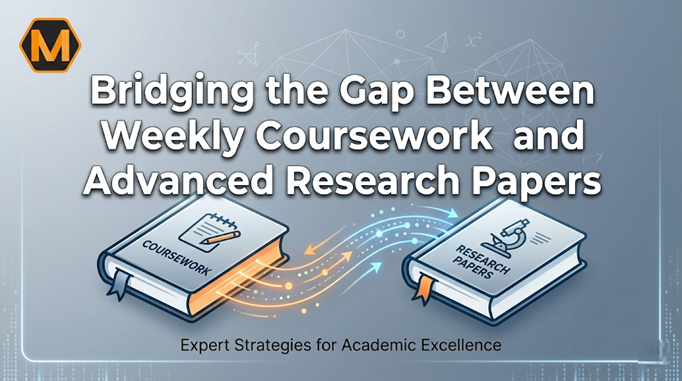
The transition from undergraduate coursework to advanced research is often described by students as a “leap of faith.” In your first few years of university, the focus is largely on consumption: reading textbooks, attending lectures, and summarizing existing knowledge in weekly assignments. However, as you progress toward your final year or postgraduate studies, the expectation shifts from consumption to contribution. You are no longer just a student; you are a budding researcher expected to provide “Information Gain” to your field.

Bridging this gap requires a fundamental shift in how you manage your time and your intellectual energy. While weekly tasks focus on immediate deadlines, advanced research requires a long-term vision. To maintain high grades during this transition, many students find that seeking the best assignment help allows them to clear their schedule of routine tasks, giving them the mental “breathing room” necessary to tackle complex dissertation methodologies and primary data collection.
Understanding the Core Differences
Weekly coursework and advanced research papers may both require “writing,” but they are different species of academic labor. Coursework is typically “reactive”—you react to a prompt provided by a professor. Research is “proactive”—you identify a gap in existing literature and propose a way to fill it.
| Feature | Weekly Coursework | Advanced Research Papers |
| Primary Goal | Demonstrate understanding of module content. | Contribute new insights or data to the field. |
| Scope | Narrow focus on a specific weekly topic. | Broad integration of multiple theories and data. |
| Structure | Standard essay format (Intro, Body, Conclusion). | Modular (Abstract, Intro, Literature Review, Methodology, Results). |
| Timeline | 1–2 weeks. | 3–6 months (or longer). |
| Feedback Loop | Grade and brief comments. | Peer reviews, supervisor meetings, and revisions. |
The “Modular” Approach to Research
One of the biggest mistakes undergraduates make when starting a thesis is treating it like a “giant essay.” If you try to write a 10,000-word paper in one go, you will burn out. Instead, treat it as a series of interconnected projects.
- The Literature Review: This is your foundation. You aren’t just listing books; you are mapping the “conversation” of your subject.
- The Methodology: This is the “how” and “why.” Whether you are using qualitative interviews or quantitative data, your logic must be bulletproof.
- Data Synthesis: This is where you move beyond what others have said and present your findings.
When the complexity of data analysis becomes overwhelming, utilizing a professional MyAssignmentHelp research paper writing service can be a strategic move. This isn’t about bypassing the work; it’s about seeing a gold-standard example of how professional researchers structure their arguments and cite complex data sets. By analyzing a professionally drafted paper, you can learn the nuances of academic tone and “Information Gain” that are often missed in standard classroom lectures.
Developing a “Global Tone” in Your Writing
In 2026, academia is more interconnected than ever. Whether you are studying in London, Dubai, or New York, your research should be accessible to a global audience. This means avoiding local slang and overly specific cultural references unless they are the subject of your study.
A global academic tone is characterized by:
- Objectivity: Use evidence-based claims rather than personal opinions.
- Clarity: Avoid “word salad.” If you can say it in ten words, don’t use twenty.
- Precision: Instead of saying “a lot of people,” say “a significant majority of respondents (68%).”
Mastering the Technicalities: E-E-A-T and Beyond
Google’s ranking systems and university marking rubrics actually look for the same things: Experience, Expertise, Authoritativeness, and Trustworthiness (E-E-A-T). When you write your research paper, you are building your own “authority.”
To do this effectively, ensure your citations are impeccable. Inconsistent referencing is the fastest way to lose the trust of your reader. Whether you use APA, MLA, or Harvard, stick to it with robotic consistency. Furthermore, focus on “Critical Analysis” rather than “Description.” A descriptive writer tells you what happened; a critical writer tells you why it matters and what the implications are for the future.
The Role of Feedback in Your Growth
Many students fear the feedback process, viewing a red-inked page as a sign of failure. In advanced research, feedback is your most valuable asset. Every critique from a supervisor is a roadmap to a higher grade.
Take the “Iteration” approach:
- Draft 1: Get your ideas on paper. Don’t worry about perfect grammar.
- Draft 2: Refine the structure. Ensure the transition between your Literature Review and Methodology is seamless.
- Draft 3: Polishing. Check your “Global Tone” and ensure your links to evidence are strong.
Strategic Time Management for the Final Year

The final year of an undergraduate degree is a balancing act. You have weekly seminars, exams, and the looming shadow of a major research project. The “Priority Matrix” is a helpful tool here. Categorize your tasks into “Urgent/Important” (Weekly assignments) and “Non-Urgent/Highly Important” (Research paper).
The trap most students fall into is ignoring the research paper because the deadline is months away. By the time it becomes “Urgent,” it is too late to produce high-quality, original work. Devote at least five hours a week to your research from day one, even if it’s just searching for journals or refining your research question.
Final Thoughts: Embracing the Challenge
The shift from coursework to research is the moment you transition from being a student to being a scholar. It is a challenging, sometimes frustrating process, but it is also where the most significant intellectual growth happens. By using the right resources, maintaining a global perspective, and treating your paper as a modular project rather than a monolithic task, you can bridge the gap and achieve the First-Class results you are aiming for.
Frequently Asked Questions (FAQ)
Q1: Is it okay to use professional academic services for my research paper?
A: Yes, many students use professional services like MyAssignmentHelp as a benchmarking tool. Seeing how an expert structures a 1200-word research module can provide a template that helps you organize your own original findings. It is a way to supplement your learning and ensure your work meets international standards.
Q2: How do I choose a research topic that isn’t too broad?
A: Start with a broad interest (e.g., “Renewable Energy”) and keep adding constraints until it is specific (e.g., “The Impact of Solar Subsidies on Small Businesses in North Africa, 2020-2025”). A specific topic is always easier to research than a general one.
Q3: What is the most important part of an advanced research paper?
A: While every section matters, the Methodology is often the “make or break” section. If your methods are flawed, your results—no matter how interesting—will be considered invalid by examiners.
Q4: How can I make my writing sound more “Global”?
A: Focus on standard English, define any niche technical terms the first time you use them, and ensure your arguments are supported by data that would be recognized by experts regardless of their geographic location.
Q5: How many sources should I include in a long-form research paper?
A: For a 1400-word section or paper, aim for at least 10–15 high-quality, peer-reviewed sources. For a full dissertation (8,000+ words), this number often jumps to 40 or more. Quality of sources always beats quantity.
About The Author
Hello! I’m Ruby Walker, and I am a senior academic consultant and SEO content strategist dedicated to helping students navigate the complexities of higher education. My primary goal is to bridge the gap between classroom learning and professional career readiness by providing actionable, high-quality insights.