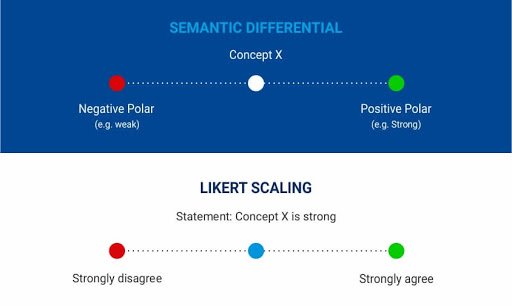
Understanding how to measure attitudes, opinions, and perceptions is a cornerstone of effective research. The semantic differential scale vs likert scale debate frequently arises among researchers and survey designers, as both tools are widely used but serve different purposes. Selecting the right scale ensures data accuracy, meaningful insights, and reliable results that inform decisions.


Researchers, marketers, and UX professionals often face challenges in choosing the best scale for their surveys. While both scales produce ordinal data, the semantic differential scale vs likert scale comparison highlights differences in methodology, structure, and analytical potential. Understanding these distinctions helps in designing surveys that truly capture what respondents feel or think.
What is a Likert Scale?
A Likert Scale is a popular measurement tool designed to quantify agreement with specific statements. Respondents indicate their position along a scale, usually ranging from “Strongly Disagree” to “Strongly Agree,” with five to seven points in total. This structure provides a clear and standardised approach to measuring opinions.
The strength of a Likert Scale lies in its simplicity and familiarity. It is widely used in academic, business, and UX research because it is straightforward to implement and easy to analyse. However, when comparing semantic differential scale vs likert scale, the limitation of Likert is its focus on agreement alone, which may not capture subtle or emotional responses effectively.
What is a Semantic Differential Scale?
The Semantic Differential Scale is a tool used to measure attitudes along a continuum between two bipolar adjectives, such as “Good – Bad” or “Fast – Slow.” This type of scale is especially effective in assessing nuanced perceptions and emotional reactions to products, brands, or experiences.
Unlike the Likert Scale, Semantic Differential Scales allow respondents to express multi-dimensional evaluations, revealing subtler insights. When evaluating semantic differential scale vs likert scale, it is clear that this method excels in capturing subjective impressions and emotional subtleties, which are often missed by agreement-focused tools.
Key Differences Between Likert and Semantic Differential Scales
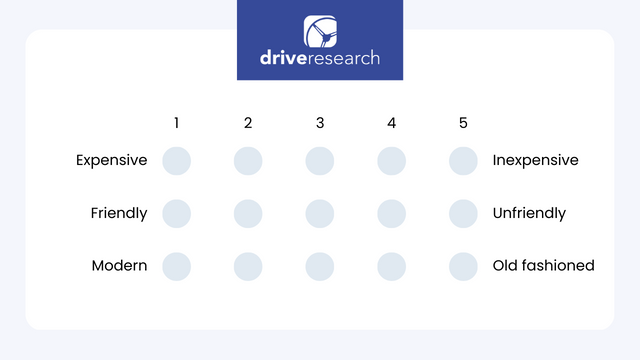
The main difference between these scales lies in the nature of what they measure. Likert focuses on agreement or disagreement with a statement, providing a structured measure of attitude. In contrast, Semantic Differential Scales measure feelings and perceptions across a range of opposing adjectives, offering deeper insights.
Analytically, Likert Scales are ideal for hypothesis testing or assessing satisfaction, while Semantic Differential Scales are better suited for exploratory research or brand perception studies. When comparing semantic differential scale vs likert scale, the distinction in purpose and structure is essential for survey designers to consider.
When to Use Each Scale
Choosing between these scales depends on research objectives. A Likert Scale is appropriate when the goal is to test a specific hypothesis, measure agreement with clear statements, or collect standardised data for quantitative analysis.
The Semantic Differential Scale is more suitable when exploring user perceptions, brand image, or emotional responses. Understanding the semantic differential scale vs likert scale comparison ensures that researchers select the right tool, avoiding misinterpretation and maximising the value of collected data.
Examples of Likert and Semantic Differential Scales
A typical Likert Scale question might ask: “I find the website easy to navigate,” with response options ranging from “Strongly Disagree” to “Strongly Agree.” This provides structured, straightforward data on user agreement.
A Semantic Differential Scale question, on the other hand, could be: “Rate the website: Friendly – Unfriendly,” allowing respondents to express nuanced impressions. These examples illustrate practical applications of semantic differential scale vs likert scale, demonstrating their respective advantages in capturing either structured agreement or nuanced attitudes.
Tips for Designing Effective Rating Scales
Designing effective scales requires attention to clarity and bias avoidance. Questions should be easy to understand, free from leading language, and consistent across the survey. A well-designed survey ensures the reliability of both Likert and Semantic Differential data.
Combining both scales in a survey can provide comprehensive insights. Use Likert for structured agreement questions and Semantic Differential for capturing subtle emotional nuances. Applying the semantic differential scale vs likert scale comparison strategically can maximise the quality and depth of survey results.
Conclusion
Both Likert and Semantic Differential Scales are powerful tools in research, but their uses are distinct. Likert is best for measuring agreement with clear statements, while Semantic Differential is ideal for capturing emotional and nuanced perceptions. Choosing the correct scale based on the semantic differential scale vs likert scale comparison ensures accurate, meaningful, and actionable insights.
Frequently Asked Questions
What is the difference between a Likert Scale and a Semantic Differential Scale?
Can both scales be used in the same survey?
Which scale is better for measuring emotions?
How many points should a Likert Scale include?
Are Semantic Differential Scales more challenging for respondents?
Can Likert Scales capture nuanced opinions?
How should data from each scale be analysed?
Are these scales commonly used in UX research?